Ambient temperature sensors are one of the most fundamental components in modern weather stations and environmental monitoring systems. They measure the surrounding air temperature and provide essential data for weather forecasting, climate analysis, industrial control, and environmental protection.
Although the concept seems simple, ambient temperature data plays a critical role in a wide range of industries. From solar power plants to smart cities, agriculture to transportation systems, accurate temperature readings are essential for decision-making, automation, and safety.
This article explores the top applications of ambient temperature sensors in weather stations and environmental monitoring, and explains how they contribute to modern data-driven systems.
One of the most traditional and important applications of ambient temperature sensors is in meteorological weather stations.
Measuring daily air temperature trends
Supporting short-term and long-term weather forecasts
Collecting climate data for national meteorological agencies
Ambient temperature is a core parameter in understanding atmospheric behavior. It influences:
Cloud formation
Air pressure systems
Wind patterns
Rainfall prediction
Without accurate temperature data, weather forecasting models would lose significant reliability.
National weather stations deploy high-precision ambient temperature sensors installed inside radiation shields to avoid direct sunlight interference. These sensors continuously transmit data to forecasting centers for climate modeling.
In solar photovoltaic (PV) systems, ambient temperature directly affects energy production efficiency.
Monitoring environmental conditions around solar panels
Optimizing inverter performance
Supporting performance ratio (PR) calculations
Solar panel efficiency decreases as temperature increases. By tracking ambient temperature, operators can:
Predict power output fluctuations
Prevent overheating issues
Improve system efficiency analysis
A large-scale solar farm uses ambient temperature sensors combined with solar radiation sensors to evaluate how heat impacts energy generation throughout the day. This data helps optimize panel layout and maintenance scheduling.
Agriculture is one of the fastest-growing sectors using environmental sensors.
Monitoring field and greenhouse temperature conditions
Automating irrigation systems
Optimizing crop growth environments
Temperature directly affects:
Seed germination
Plant growth rate
Pest and disease development
In modern greenhouses, ambient temperature sensors are integrated with IoT control systems. When temperature exceeds a threshold, ventilation fans and cooling systems are automatically activated to maintain optimal growing conditions.
Cities are increasingly deploying environmental monitoring systems to improve air quality and urban living conditions.
Urban heat island effect monitoring
Air quality system calibration
Climate adaptation planning
Urban environments often experience higher temperatures due to:
Dense infrastructure
Traffic emissions
Lack of green spaces
Ambient temperature sensors help city planners understand and mitigate these effects.
A smart city network installs temperature sensors on streetlight poles to collect real-time microclimate data. This data is used to design cooling strategies and improve urban green infrastructure.
Factories, warehouses, and production facilities require stable environmental conditions.
Equipment protection
Production environment control
Worker safety monitoring
Many industrial processes are sensitive to temperature variations, including:
Electronics manufacturing
Chemical processing
Food storage
In a manufacturing plant, ambient temperature sensors are connected to a centralized control system. If temperature rises above safe limits, cooling systems are automatically activated to protect equipment and maintain product quality.
Ambient temperature sensors are widely used in transportation systems to ensure safety and operational efficiency.
Road condition monitoring
Railway system safety
Airport weather stations
Temperature changes can lead to:
Ice formation on roads
Rail expansion or contraction
Aircraft performance risks
Airports use ambient temperature sensors as part of runway weather stations to ensure safe takeoff and landing conditions. Temperature data is combined with wind and humidity data for aviation safety decisions.
Scientific research relies heavily on accurate temperature data.
Climate change studies
Ecosystem monitoring
Environmental impact assessments
Long-term temperature records are essential for:
Understanding global warming trends
Studying ecosystem changes
Supporting environmental policy decisions
Research institutions deploy remote environmental stations in forests and mountains to collect long-term temperature data. This helps scientists analyze climate variation over decades.
Modern data centers require precise temperature control to ensure stable operation.
Server room temperature monitoring
Cooling system optimization
Preventing overheating failures
Even small temperature increases can:
Reduce server performance
Increase energy consumption
Cause system failures
Large data centers use distributed ambient temperature sensors to monitor hot and cold aisle conditions. This helps optimize airflow and reduce cooling costs.
Hybrid renewable energy systems rely on environmental data for optimization.
System performance prediction
Energy balancing
Environmental condition tracking
Temperature affects both:
Wind density (indirectly affecting wind power)
Solar panel efficiency
A hybrid wind-solar station uses ambient temperature sensors to optimize energy distribution between wind turbines and solar panels based on environmental conditions.
Ambient temperature sensors also contribute to disaster prevention systems.
Wildfire risk monitoring
Heatwave alerts
Extreme weather detection
Sudden temperature increases can indicate:
Fire risks in forests
Heatwave conditions
Dangerous environmental changes
Remote forest monitoring stations use ambient temperature sensors combined with humidity sensors to detect fire risk levels and trigger early warning alerts.
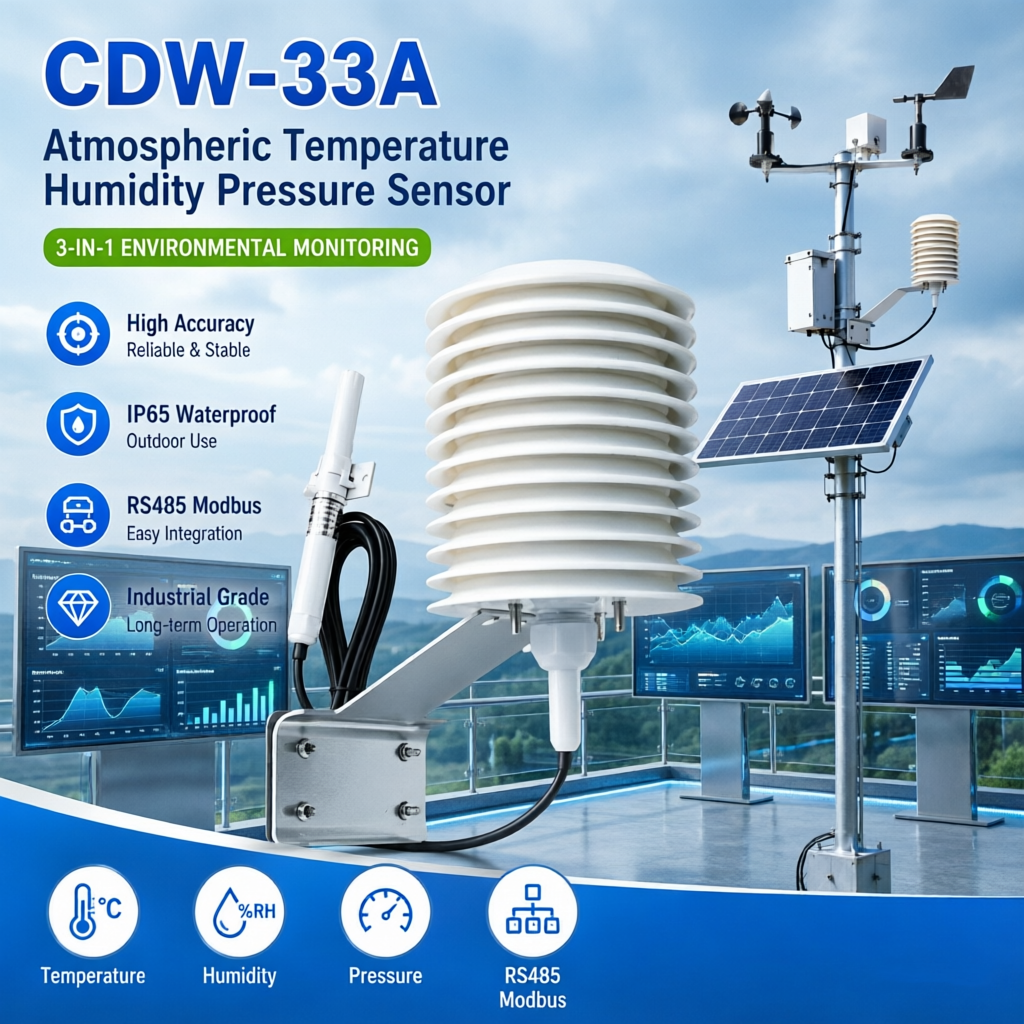
Across all applications, ambient temperature sensors provide several key advantages:
Real-time environmental monitoring
Improved decision-making
System automation support
Risk reduction and safety enhancement
Energy efficiency optimization
Long-term climate data collection
Despite their importance, ambient temperature sensors face several challenges:
Direct sunlight or heat sources can distort readings if not properly shielded.
Long-term accuracy requires periodic calibration.
Extreme environments such as deserts, mountains, or coastal areas may reduce sensor lifespan.
Poor placement can lead to inaccurate data collection.
The future of ambient temperature sensing is evolving rapidly with technology advancements.
Sensors now connect directly to cloud platforms for real-time monitoring.
Artificial intelligence improves prediction accuracy using temperature data patterns.
Ideal for remote and solar-powered installations.
Temperature sensors are increasingly combined with humidity, pressure, and gas sensors in compact devices.
Ambient temperature sensors are a fundamental part of modern weather stations and environmental monitoring systems. Their applications span across meteorology, agriculture, renewable energy, smart cities, industrial automation, transportation, and scientific research.
By providing accurate and continuous temperature data, these sensors enable smarter decision-making, improved efficiency, and enhanced safety across multiple industries.
As technology continues to advance, ambient temperature sensors will become even more intelligent, connected, and essential in building a sustainable and data-driven future.
What are the uses of a rain gauge? Learn how rai
Learn how PAR sensors measure PPFD, optimize gro
Learn how soil EC sensors help optimize fertiliz
Contact: Molly
Phone: +86-17775769236
Tel: 86-0731-85117089
Email: molly@codasensor.com
Add: Building S5, Aux Square, Yuelu District, Changsha City, Hunan Province, China
We chat






 English


