Urban air pollution has become a critical global issue, driven by rapid urbanization, transportation emissions, industrial expansion, and energy consumption. According to global environmental studies, more than 90% of people in cities are exposed to air quality levels that exceed WHO guidelines.
To address this challenge, cities are increasingly deploying environmental sensors as part of intelligent air quality monitoring systems. These sensors provide continuous, real-time, and high-density environmental data that traditional monitoring stations alone cannot deliver.
This article explains how environmental sensors work, their role in modern urban monitoring systems, and two real-world case studies demonstrating their impact.
Environmental sensors are electronic devices that detect and measure environmental parameters and convert them into digital signals for analysis.
In urban air quality monitoring, they typically measure:
Particulate Matter: PM2.5, PM10
Gases: CO, CO₂, NO₂, SO₂, O₃
Volatile Organic Compounds (VOCs)
Meteorological factors: temperature, humidity, wind speed, pressure
These sensors are often integrated into:
Smart city monitoring stations
IoT-based distributed sensor networks
Roadside environmental monitoring systems
Industrial boundary monitoring systems
Environmental sensors function through a combination of physical detection, signal conversion, and digital communication.
Different pollutants require different sensing technologies:
Optical scattering sensors → detect particulate matter (PM2.5/PM10)
Electrochemical sensors → measure toxic gases like NO₂ and CO
NDIR infrared sensors → measure CO₂ concentration
Metal-oxide sensors → detect VOCs and air quality variations
Each technology responds differently to environmental changes, ensuring multi-layered detection capability.
Once pollutants interact with the sensing element, the physical change is converted into an electrical signal such as:
Voltage variation
Resistance change
Current output
At this stage, modern systems apply:
Temperature compensation
Humidity correction
Baseline drift adjustment
Factory and field calibration models
This ensures data consistency across large sensor networks.
Before transmission, many modern environmental sensors perform edge computing, including:
Noise reduction
Outlier removal
Data smoothing algorithms
Local threshold detection
This reduces cloud processing load and improves real-time responsiveness.
Sensor data is transmitted through:
4G/5G cellular networks
LoRaWAN (low-power wide-area networks)
NB-IoT for smart city infrastructure
Ethernet in fixed installations
Data is then visualized on cloud platforms for:
Real-time dashboards
Historical trend analysis
AI-based forecasting models
Public air quality index systems
Traditional air monitoring systems rely on a small number of high-precision stations. While accurate, they lack spatial resolution.
Environmental sensor networks solve this problem by enabling:
Dense monitoring coverage (street-level data)
Real-time pollution mapping
Hyperlocal air quality tracking
Early detection of pollution spikes
Integration with smart city infrastructure
A major European capital city faced increasing air pollution from:
Traffic congestion in central districts
Diesel vehicle emissions
Construction dust from infrastructure expansion
Seasonal heating emissions in winter
Traditional monitoring stations (fewer than 10 across the city) were insufficient for identifying localized pollution variations.
The city deployed a distributed environmental sensor network consisting of:
Roadside monitoring nodes at major intersections
Sensors installed on traffic lights and lamp posts
Monitoring units placed near schools and hospitals
Industrial boundary air quality stations
Each node measured:
NO₂
CO₂
Temperature and humidity
Data was transmitted via LTE/4G to a centralized cloud platform.
The city developed a high-resolution air quality map showing pollution variations at street level rather than district level.
This revealed that:
Narrow traffic corridors had 2–3× higher NO₂ levels
Certain intersections were consistent pollution hotspots
Residential zones near highways experienced nighttime pollution peaks
Authorities integrated air quality data with traffic control systems:
Adjusted traffic light timing in high-emission zones
Diverted traffic during peak pollution periods
Encouraged low-emission routes for public transport
A citizen-facing mobile application provided:
Real-time AQI updates
Pollution exposure alerts for sensitive groups
Recommendations for outdoor activity timing
After 12 months:
Significant improvement in public awareness
Measurable reduction in peak-hour NO₂ exposure
Better urban planning decisions based on environmental data
A large industrial manufacturing zone with chemical plants, metal processing facilities, and logistics hubs faced regulatory pressure due to:
Frequent NO₂ and SO₂ emission spikes
Particulate matter exceeding safe limits
Difficulty identifying emission sources in real time
Traditional compliance checks were periodic and reactive, not continuous.
A multi-layer environmental sensor system was deployed:
Perimeter monitoring stations around industrial boundaries
High-sensitivity gas sensors near emission stacks
PM2.5 sensors in nearby residential zones
Weather stations integrated for dispersion analysis
NO₂, SO₂, CO, O₃
PM2.5 / PM10
Temperature and humidity
By correlating wind direction with pollutant spikes, authorities could:
Trace emissions back to specific factories
Identify abnormal discharge events within minutes
Verify compliance automatically instead of manual inspections
When pollutant thresholds were exceeded:
Automatic alerts were sent to environmental agencies
Facility managers received real-time notifications
Data logs were stored for compliance reporting
Continuous monitoring created strong enforcement pressure:
Factories upgraded filtration systems
Reduced unauthorized emissions
Improved operational environmental standards
Within one year:
Noticeable reduction in SO₂ emission peaks
Faster regulatory response time
Improved transparency between industry and government
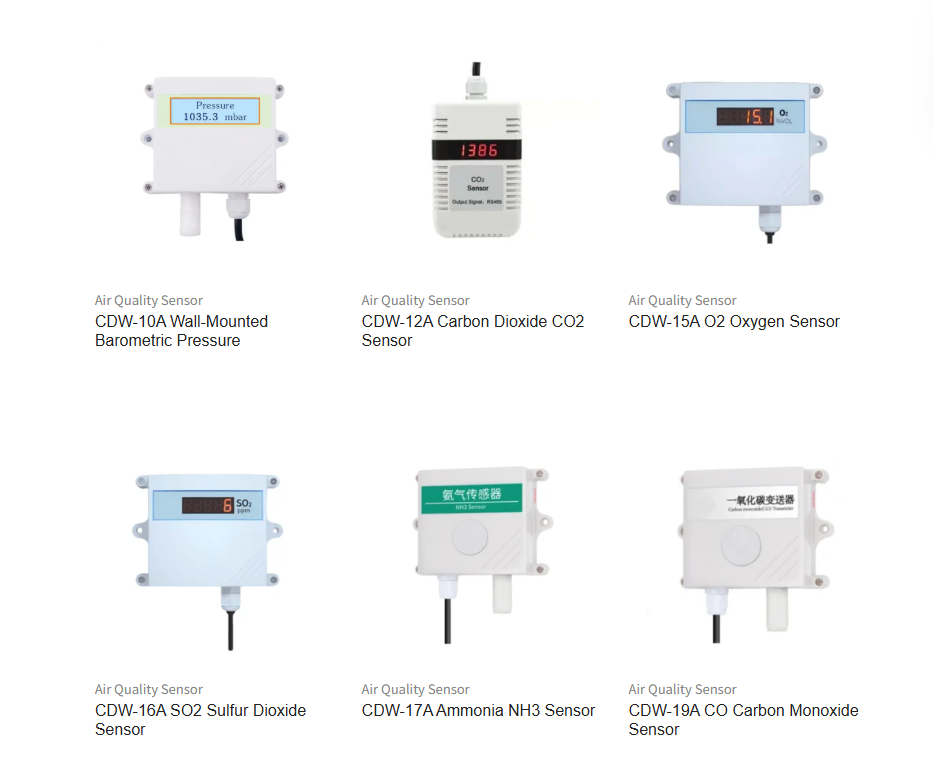
Environmental sensor networks provide:
Continuous real-time monitoring
High spatial resolution data
Faster pollution response mechanisms
Better environmental policy enforcement
Integration with IoT and smart city systems
Cost-effective scalability compared to traditional stations
Despite their advantages, environmental sensors face several challenges:
Long-term exposure to pollution can affect accuracy without periodic recalibration.
Humidity and temperature fluctuations can influence gas sensor readings.
Low-cost sensors may require calibration against reference-grade stations.
Outdoor installations require protection from dust, rain, and corrosion.
Advanced solutions now use:
AI-based calibration models
Sensor fusion techniques
Hybrid reference + low-cost networks
The future of environmental sensor systems includes:
AI-driven pollution forecasting
Edge computing inside sensors
Satellite + ground sensor integration
Ultra-dense sensor networks (hyperlocal monitoring)
Autonomous smart city environmental control systems
They provide real-time monitoring of air pollutants and environmental conditions to support public health and smart city management.
High-quality sensors are reliable for network-scale monitoring, but they are often calibrated against reference stations for validation.
It depends on city size, but modern smart cities often deploy hundreds or thousands of sensors for high-resolution mapping.
Most systems detect key pollutants such as PM2.5, PM10, CO₂, NO₂, SO₂, O₃, and VOCs depending on configuration.
They use IoT communication technologies such as 4G, LoRaWAN, NB-IoT, Wi-Fi, or Ethernet.
Typically 3–8 years depending on sensor type, environment, and maintenance practices.
Traditional stations are highly accurate but sparse; sensor networks provide dense, real-time spatial coverage.
Environmental sensors are reshaping urban air quality monitoring by enabling real-time, scalable, and high-resolution environmental intelligence. Through distributed sensor networks, cities can detect pollution faster, respond more effectively, and design smarter urban environments.
The combination of IoT, AI, and environmental sensing is transforming cities from reactive systems into proactive, data-driven ecosystems that prioritize public health and sustainability.
What are the uses of a rain gauge? Learn how rai
Learn how PAR sensors measure PPFD, optimize gro
Learn how soil EC sensors help optimize fertiliz
Contact: Molly
Phone: +86-17775769236
Tel: 86-0731-85117089
Email: molly@codasensor.com
Add: Building S5, Aux Square, Yuelu District, Changsha City, Hunan Province, China
We chat






 English


