In modern agriculture, monitoring environmental conditions has become increasingly important for protecting crops and improving productivity. Farmers today face many challenges, including unpredictable weather patterns, increasing disease pressure, and the need to produce higher yields with fewer resources. To address these challenges, growers are turning to environmental monitoring technologies that provide real-time data about field conditions.
One of the most important environmental factors influencing plant health is leaf wetness. Leaf wetness refers to the presence and duration of water on plant leaves. This moisture may come from rainfall, irrigation, dew, fog, or high humidity. While moisture is essential for plant growth, prolonged wetness on leaf surfaces can create ideal conditions for fungal and bacterial pathogens.
Many plant diseases depend on specific combinations of leaf wetness duration, temperature, and humidity in order to infect crops. As a result, monitoring leaf wetness has become an important tool in modern crop protection strategies.
This is where leaf wetness sensors play a crucial role. These sensors help farmers measure the presence and duration of moisture on leaf surfaces, allowing them to better understand crop microclimates and predict disease risks.
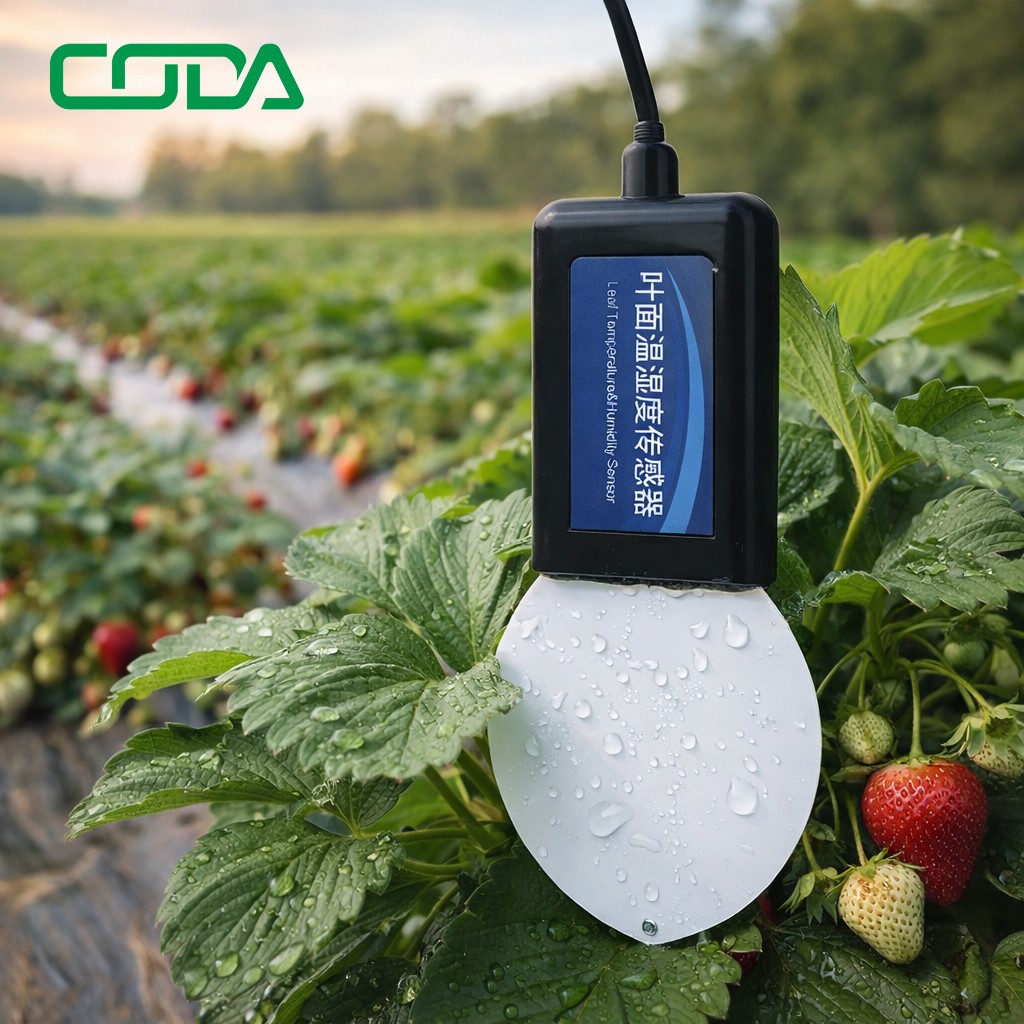
A leaf wetness sensor is a device designed to simulate the surface of a natural plant leaf and detect when moisture is present. These sensors are commonly used in agricultural monitoring systems to measure how long plant leaves remain wet after rainfall, irrigation, or dew formation.
The sensor typically consists of a flat sensing surface that mimics the thermal and physical properties of real leaves. When water droplets accumulate on the surface, the sensor detects the moisture and records the wetness duration.
Leaf wetness sensors are usually installed within the plant canopy or near crop leaves so that they experience the same environmental conditions as the plants themselves. This placement allows the sensor to provide a realistic representation of how wet the crop foliage actually is.
The data collected by leaf wetness sensors is extremely valuable for farmers, researchers, and agricultural advisors because it helps determine when crops may become vulnerable to disease.
Leaf wetness plays a major role in the life cycle of many plant pathogens. Fungal spores are commonly present in the environment and can land on plant leaves through wind, rain splash, insects, or soil particles. However, many of these spores cannot germinate unless free water is present on the leaf surface.
When leaves remain wet for extended periods, fungal spores can absorb water and begin germination. Once germinated, the pathogen can penetrate the plant tissue and start spreading inside the leaf. This process may lead to visible symptoms such as spots, mold growth, or plant decay.
Many common plant diseases are closely linked to leaf wetness conditions, including:
Downy mildew
Late blight
Early blight
Botrytis (gray mold)
Apple scab
Leaf spot diseases
Even if these pathogens are present in the environment, infection may not occur if leaves dry quickly. However, when leaves stay wet for several hours, the risk of infection increases significantly.
For this reason, measuring leaf wetness duration is a key part of many agricultural disease forecasting models.
Leaf wetness sensors use electronic sensing technology to detect the presence of water on their surface. While different sensor designs exist, most operate based on changes in electrical properties caused by moisture.
One of the most common sensing methods uses electrical conductivity. In this design, the sensor surface contains a grid of conductive traces embedded in the sensing plate.
When the sensor is dry, electrical resistance between the traces remains high because there is no conductive path. However, when water droplets accumulate on the surface, the water creates a conductive bridge between the traces. This reduces resistance and allows a small electrical current to pass through the sensor.
The sensor electronics measure this change in conductivity and determine whether the surface is wet or dry. The data can then be recorded or transmitted to a monitoring system.
Some advanced leaf wetness sensors use capacitive sensing instead of conductivity. Capacitive sensors detect changes in the electrical field around the sensor surface when water is present.
Because water has different dielectric properties than air, the presence of water droplets alters the capacitance of the sensing surface. The sensor electronics detect this change and convert it into a measurable signal.
Capacitive sensors can be more stable and less affected by contamination such as dust or salts on the sensor surface.
Environmental temperature can influence evaporation rates and moisture detection. For this reason, many modern leaf wetness sensors include temperature compensation features.
By measuring temperature alongside moisture, the sensor can improve measurement accuracy and better represent real leaf conditions.
One of the most important measurements provided by leaf wetness sensors is leaf wetness duration (LWD). This parameter refers to the total amount of time that leaf surfaces remain wet during a given period.
Leaf wetness duration is typically measured in hours. For example, if rain begins in the evening and leaves remain wet until the following morning, the wetness duration might be recorded as 10 to 12 hours.
Different plant pathogens require different wetness durations to infect crops. Some diseases may require only a few hours of wetness, while others may need longer periods combined with specific temperature ranges.
By analyzing leaf wetness duration together with temperature data, disease forecasting models can estimate the probability of infection. This allows farmers to respond more effectively to potential outbreaks.
Leaf wetness sensors are often integrated into agricultural weather stations, which monitor multiple environmental parameters simultaneously.
A typical agricultural weather station may include sensors that measure:
Air temperature
Relative humidity
Rainfall
Solar radiation
Wind speed and wind direction
Leaf wetness
By combining these measurements, farmers can obtain a comprehensive understanding of the environmental conditions affecting their crops.
For example, certain plant diseases may develop only when temperature and leaf wetness fall within specific ranges. Weather station data allows farmers to monitor these conditions in real time and make informed decisions about crop protection.
Modern weather stations can also transmit data to cloud-based platforms, allowing growers to monitor field conditions remotely using computers or mobile devices.
Leaf wetness sensors are widely used in many areas of agriculture and environmental monitoring.
Grape growers rely on leaf wetness monitoring to predict conditions that may lead to downy mildew and Botrytis infections. Early detection helps prevent crop losses and protect fruit quality.
Fruit orchards often monitor leaf wetness to predict diseases such as apple scab and pear leaf spot.
Vegetable crops such as tomatoes, cucumbers, and peppers are particularly vulnerable to fungal diseases triggered by prolonged leaf wetness.
In greenhouse environments, leaf wetness sensors help growers control humidity, irrigation, and ventilation to maintain optimal plant health.
Researchers use leaf wetness data to develop improved crop disease prediction models and optimize farming practices.
Using leaf wetness sensors provides several advantages for modern farming operations.
Early disease detection allows farmers to identify high-risk conditions before infections spread widely.
Reduced pesticide use is possible because farmers can apply fungicides only when environmental conditions favor disease development.
Improved crop quality results from better disease prevention and healthier plant growth.
Data-driven farming allows growers to make more accurate decisions about irrigation, crop protection, and environmental management.
These benefits make leaf wetness monitoring an important component of precision agriculture systems.
As agricultural technology continues to evolve, environmental monitoring systems are becoming more advanced and interconnected. Many farms are now adopting IoT-based monitoring networks that combine multiple sensors with cloud-based data analysis.
In the future, leaf wetness sensors may work alongside artificial intelligence models that analyze weather data and predict disease outbreaks automatically. Farmers could receive real-time alerts when environmental conditions reach thresholds that favor pathogen growth.
These innovations will allow growers to respond more quickly to potential threats and manage crops more efficiently.
Leaf wetness sensors are an essential tool for modern agriculture. By measuring the presence and duration of moisture on leaf surfaces, these sensors provide valuable insights into environmental conditions that influence plant disease development.
When integrated with agricultural weather stations and precision farming technologies, leaf wetness sensors help farmers monitor crop microclimates, predict disease risks, and make better management decisions.
As agriculture continues to move toward data-driven farming practices, leaf wetness monitoring will play an increasingly important role in protecting crops, improving yields, and supporting sustainable food production.
What are the uses of a rain gauge? Learn how rai
Learn how PAR sensors measure PPFD, optimize gro
Learn how soil EC sensors help optimize fertiliz
Contact: Molly
Phone: +86-17775769236
Tel: 86-0731-85117089
Email: molly@codasensor.com
Add: Building S5, Aux Square, Yuelu District, Changsha City, Hunan Province, China
We chat






 English


