In modern agriculture, precision management of soil health is crucial for achieving high yields, optimizing input costs, and ensuring environmental sustainability. One of the key soil parameters that influence crop productivity and fertilizer efficiency is soil Electrical Conductivity (EC). Understanding soil EC and monitoring it effectively can help farmers apply fertilizers more accurately, avoid nutrient imbalances, and improve overall crop performance. Advanced soil sensors, like those from Coda Sensor, make it easier than ever to monitor this vital parameter in real time.
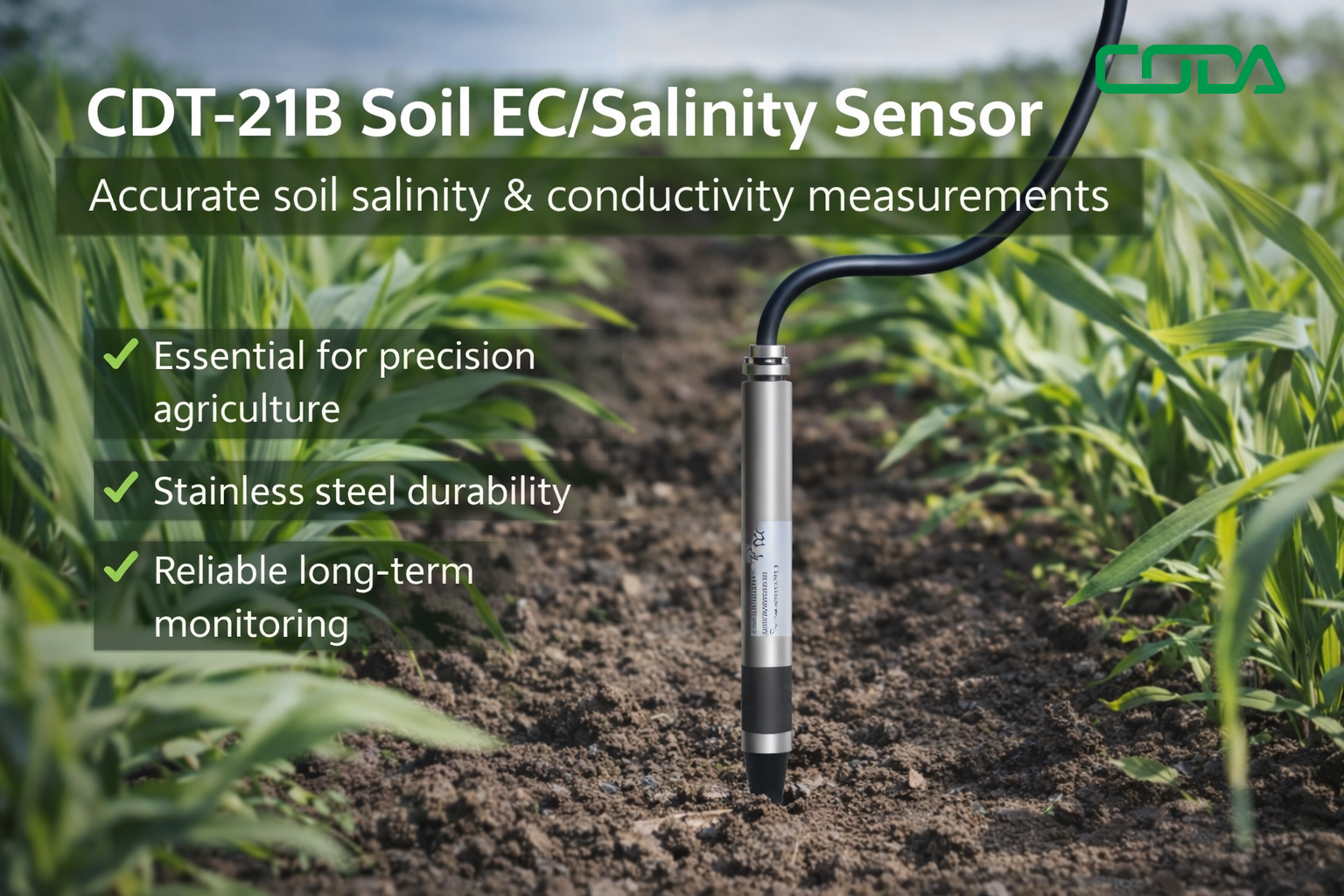
Soil EC is a measure of the soil’s ability to conduct an electric current. It provides an indirect measurement of the concentration of soluble salts and nutrients in the soil solution. The higher the EC, the more salts are present. While salts are necessary for plant growth, excessively high EC can hinder water uptake and nutrient absorption, leading to crop stress. Conversely, very low EC indicates poor nutrient availability, which can reduce plant growth and productivity.
Soil EC is influenced by several factors, including:
Soil Texture: Sandy soils typically have lower EC due to lower cation exchange capacity, whereas clay and loam soils have higher EC values.
Moisture Content: EC increases with soil moisture because water acts as a conductor for ions.
Fertilizer Application: Adding fertilizers increases soluble salts, which raises EC.
Organic Matter: High organic matter can improve soil structure and buffer EC fluctuations.
Soil Temperature: Warmer soils may show slightly higher EC readings due to increased ion mobility.
Monitoring EC over time helps farmers understand nutrient dynamics and plan fertilizer applications more effectively.
Fertilizer efficiency refers to the proportion of nutrients applied that is actually taken up by plants. Soil EC plays a critical role in this process, influencing both nutrient availability and plant uptake.
EC affects how soluble nutrients like nitrogen (N), phosphorus (P), and potassium (K) are in the soil solution. In soils with extremely high EC, excessive salts can lead to nutrient antagonism, where certain ions interfere with the uptake of others. For example, high sodium levels can hinder potassium uptake. Conversely, soils with very low EC may not provide sufficient ions for plants to absorb, limiting fertilizer effectiveness.
High soil EC increases osmotic pressure in the soil, making it more difficult for plants to take up water. This stress can reduce the efficiency of water-soluble fertilizers, as plants may be unable to access nutrients in a timely manner. Monitoring EC allows farmers to adjust irrigation schedules and fertilizer application rates to minimize stress and optimize nutrient use.
Understanding EC variability in a field helps farmers decide where to place fertilizers for maximum effect. High-resolution soil EC maps can identify zones with different nutrient needs, enabling precision agriculture techniques such as variable rate fertilizer application. This not only improves crop performance but also reduces input costs and environmental impact.
Different crops have varying tolerance levels for soil EC. For example, sensitive crops like beans and strawberries may experience yield losses in slightly saline soils, while more tolerant crops like barley or cotton can handle moderate EC levels. By monitoring soil EC, farmers can select crop varieties suitable for their soil conditions and avoid stress-related losses.
Additionally, consistent EC monitoring helps identify soil salinity trends over time. Rising EC levels can indicate over-fertilization or poor drainage, prompting corrective actions such as leaching salts, improving irrigation management, or applying gypsum to mitigate sodium buildup.
Traditional soil testing methods often require labor-intensive sampling and laboratory analysis, which provide only a snapshot of soil conditions at a single point in time. With Coda Sensor’s advanced soil devices, farmers can now measure EC and other critical soil parameters in real time and with high accuracy.
Coda’s CDT-70B Soil 7-in-1 Sensor can measure soil temperature, moisture, EC, pH, and NPK levels simultaneously. This multi-parameter approach gives a complete picture of soil health, allowing farmers to correlate EC readings with other factors like soil moisture and nutrient content.
With IoT-enabled soil sensors, data on EC and other parameters is transmitted in real time to cloud platforms or mobile devices. This allows farmers to monitor field conditions continuously, detect anomalies early, and make informed decisions on fertilizer application or irrigation adjustments.
Coda sensors support integration with precision agriculture systems. By collecting EC data across different zones in a field, farmers can create detailed soil maps and implement variable rate fertilization strategies. This not only maximizes fertilizer efficiency but also minimizes environmental impact by reducing nutrient runoff.
Coda’s soil sensors are designed for long-term field deployment. They are easy to install, resistant to harsh environmental conditions, and require minimal maintenance. This ensures reliable, consistent EC monitoring throughout the growing season.
Regular Monitoring: Measure soil EC at multiple depths and locations to understand spatial and vertical variability in your field.
Adjust Fertilizer Rates: Use EC data to fine-tune fertilizer application rates, avoiding over- or under-fertilization.
Combine with Irrigation Management: High EC soils benefit from targeted irrigation to leach excess salts and reduce osmotic stress.
Track Seasonal Changes: Monitor EC before and after fertilizer application to assess efficiency and nutrient movement in the soil.
Use EC Maps for Precision Agriculture: Identify high and low EC zones in your field to apply nutrients only where needed, improving both yield and cost-efficiency.
In a vineyard setting, farmers often struggle with uneven nutrient distribution, leading to patches of underperforming vines. By deploying Coda CDT-70B Soil Sensors, growers were able to monitor EC levels across multiple vineyard rows in real time.
The sensors revealed high EC zones near older irrigation points and lower EC in newly developed areas. With this information, growers applied fertilizers selectively based on soil EC readings. Over the season, grape yield improved by 15%, and fertilizer usage decreased by 12%, demonstrating the value of precise EC monitoring for both productivity and cost savings.
Modern farming increasingly relies on data-driven decisions. Soil EC monitoring should not be treated in isolation but as part of a comprehensive nutrient management plan. By combining EC data with crop growth models, soil moisture, pH, and nutrient concentrations, farmers can:
Determine the optimal type and amount of fertilizer.
Schedule applications to match crop demand.
Identify areas at risk of salinity stress.
Reduce environmental risks by minimizing nutrient leaching.
Coda’s soil sensors simplify this integration by providing continuous, reliable, and multi-dimensional soil data, empowering farmers to implement smarter and more efficient fertilizer strategies.
Soil EC is a critical factor that directly affects fertilizer efficiency and crop health. High or low EC levels can disrupt nutrient availability, reduce water uptake, and ultimately impact yields. By leveraging advanced soil monitoring technology, like Coda Sensor’s CDT-70B Soil 7-in-1 Sensor, farmers can track EC in real time, adjust fertilization practices, and adopt precision agriculture strategies to optimize nutrient use.
Investing in soil EC monitoring not only improves crop productivity and fertilizer efficiency but also supports sustainable farming practices by reducing waste and environmental impact. As agriculture continues to evolve, real-time soil data will play an increasingly essential role in achieving high yields, efficient input management, and long-term soil health.
What are the uses of a rain gauge? Learn how rai
Learn how PAR sensors measure PPFD, optimize gro
Learn how soil EC sensors help optimize fertiliz
Contact: Molly
Phone: +86-17775769236
Tel: 86-0731-85117089
Email: molly@codasensor.com
Add: Building S5, Aux Square, Yuelu District, Changsha City, Hunan Province, China
We chat






 English


