Sunlight is one of the most fundamental resources for plant growth. Along with water, nutrients, and suitable temperatures, light provides the energy plants need to perform photosynthesis—the biological process that converts light energy into chemical energy. Without sufficient sunlight, crops struggle to grow, yields decline, and overall plant health deteriorates.
However, in modern agriculture, sunlight is not just about “how bright the day is.” Farmers and agronomists increasingly recognize that precise sunlight monitoring is essential for optimizing crop production, especially in controlled environments such as greenhouses, smart farms, and large-scale commercial agriculture.
By using professional solar radiation sensors and environmental monitoring systems, growers can measure real-time sunlight intensity and make data-driven decisions about irrigation, fertilization, shading, and greenhouse management.
This article explores why sunlight monitoring matters, how it affects crop growth, and how advanced sensors—such as those provided by Coda Sensor—help farmers improve agricultural productivity.
Sunlight drives photosynthesis, the process by which plants convert carbon dioxide and water into glucose and oxygen. The simplified equation is:
Carbon Dioxide + Water + Sunlight → Glucose + Oxygen
Glucose produced during photosynthesis becomes the primary energy source for plant growth, supporting processes such as:
Leaf development
Root expansion
Flowering
Fruit production
Nutrient absorption
If sunlight levels are insufficient, photosynthesis slows down, and plants cannot produce the energy they need for healthy development.
For many crops—such as tomatoes, grapes, wheat, and corn—light intensity directly affects yield. Even small variations in sunlight exposure can significantly influence crop quality and productivity.
Sunlight is not a single variable. Several measurable parameters influence plant growth.
Solar radiation refers to the amount of solar energy reaching a specific area over time, usually measured in W/m² (watts per square meter).
High radiation levels generally increase photosynthesis rates. However, excessive radiation can also stress plants, causing:
Leaf burn
Increased transpiration
Water loss
Reduced productivity
Monitoring solar radiation allows farmers to manage shading systems and irrigation schedules.
Many crops depend on day length to trigger biological processes such as flowering.
Examples include:
Short-day plants: Soybeans, rice
Long-day plants: Wheat, barley
Day-neutral plants: Tomatoes, cucumbers
Accurate sunlight monitoring helps farmers predict plant growth cycles and optimize planting schedules.
Even if total sunlight levels are adequate, uneven light distribution across fields or greenhouses can create inconsistent crop development.
Factors affecting light distribution include:
Cloud cover
Shade from structures or trees
Greenhouse materials
Seasonal sun angle changes
Monitoring sunlight helps identify areas with insufficient illumination so farmers can adjust crop layout or greenhouse design.
Agriculture is highly sensitive to environmental variability, and sunlight conditions can change rapidly.
Cloud cover, storms, and seasonal weather patterns can significantly reduce sunlight levels.
For example:
Prolonged cloudy conditions may reduce photosynthesis.
Sudden intense sunlight after cloudy days may stress plants.
Real-time solar monitoring helps growers respond quickly to these changes.
Climate change has introduced new uncertainties into agricultural production.
Farmers worldwide are experiencing:
More extreme weather patterns
Changing solar radiation levels
Increased heat waves
These factors make environmental monitoring systems more important than ever.
In greenhouses, sunlight conditions are partially controlled but still influenced by external weather.
Growers must manage:
Shade screens
Artificial lighting
Ventilation systems
Irrigation scheduling
Without precise sunlight data, greenhouse climate control becomes guesswork.
Solar radiation monitoring enables farmers to make better management decisions in several areas.
Sunlight directly affects plant transpiration and water demand.
When solar radiation increases:
Leaf temperature rises
Water evaporation increases
Plants require more irrigation
By integrating solar radiation data with irrigation systems, farmers can optimize water usage and prevent overwatering or drought stress.
Nutrient uptake is closely linked to photosynthesis.
When sunlight is strong:
Photosynthesis increases
Nutrient demand rises
Monitoring sunlight helps farmers adjust fertilization schedules to match plant metabolic activity, improving fertilizer efficiency.
In controlled agriculture, sunlight data can trigger automated responses such as:
Deploying shade curtains
Activating cooling systems
Adjusting ventilation
Controlling supplemental lighting
These actions help maintain optimal growing conditions.
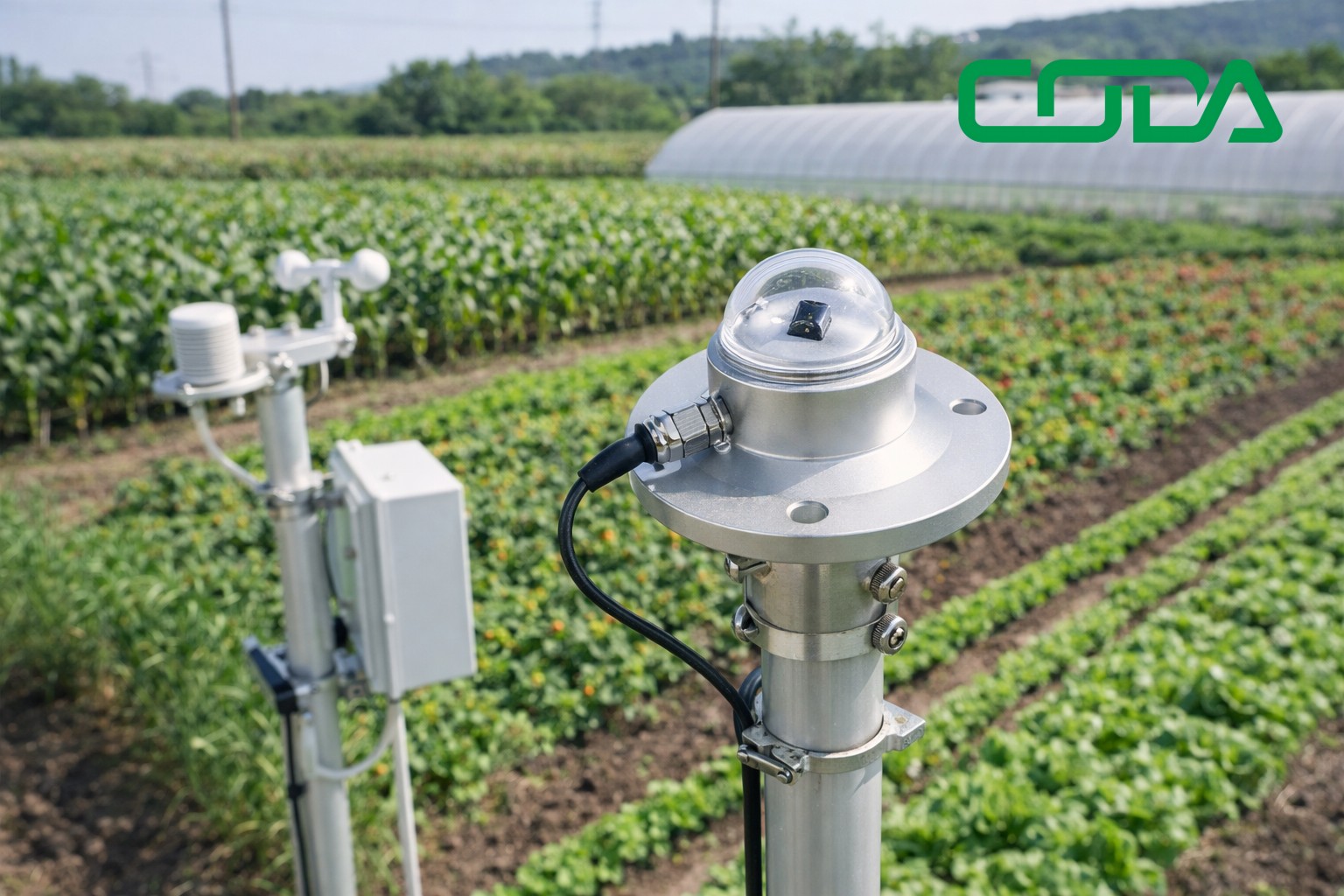
To monitor sunlight accurately, farms rely on solar radiation sensors.
These instruments measure the amount of solar energy reaching the Earth's surface and provide real-time environmental data for agricultural management.
Typical applications include:
Smart agriculture systems
Greenhouse automation
Weather stations
Agricultural research
Irrigation control systems
Solar radiation sensors are often integrated with other environmental sensors such as:
Temperature sensors
Humidity sensors
Wind sensors
Rain gauges
Together, they form a complete agricultural monitoring system.
As agriculture becomes increasingly data-driven, reliable environmental monitoring equipment is essential. Coda Sensor provides advanced solar radiation sensors designed for agricultural and environmental monitoring applications.
Coda’s solar radiation sensors offer several advantages:
The sensors provide precise solar radiation measurements, enabling farmers and researchers to track sunlight intensity accurately throughout the day.
Agricultural environments can be harsh, with exposure to rain, dust, high temperatures, and UV radiation. Coda sensors are designed with robust materials that ensure long-term reliability in outdoor conditions.
Coda solar radiation sensors support standard output interfaces such as:
RS485
Modbus protocol
Analog signals
This allows seamless integration with weather stations, IoT platforms, and agricultural control systems.
With stable performance and reliable calibration, the sensors require minimal maintenance while delivering consistent data over long periods.
Coda solar radiation sensors are widely used in modern agricultural systems.
Sunlight is critical for grape quality, affecting sugar accumulation, color development, and flavor compounds.
Solar monitoring helps vineyard managers:
Optimize canopy management
Adjust irrigation
Improve grape ripening conditions
Vegetables such as tomatoes, cucumbers, and peppers require carefully controlled light conditions.
Solar radiation sensors help greenhouse operators:
Manage shading systems
Optimize artificial lighting
Improve energy efficiency
By combining solar radiation data with soil moisture sensors, farmers can implement precision irrigation strategies that conserve water while maximizing crop growth.
Universities and research institutions use solar radiation sensors to study plant growth, climate patterns, and crop productivity under different environmental conditions.
As the global population continues to grow, agriculture must produce more food using fewer resources. Smart farming technologies are becoming essential to meet this challenge.
Sunlight monitoring will play a crucial role in the future of agriculture by enabling:
AI-driven crop management
Automated greenhouse control systems
Precision irrigation and fertilization
Climate-adaptive farming practices
With the help of advanced sensors and IoT platforms, farmers can transform raw environmental data into actionable insights that improve productivity and sustainability.
Sunlight is one of the most important factors influencing crop growth, affecting everything from photosynthesis and nutrient uptake to irrigation needs and yield potential.
However, natural sunlight conditions are highly variable. Without accurate monitoring, farmers must rely on estimates and experience, which can lead to inefficiencies and lost productivity.
By implementing solar radiation sensors and environmental monitoring systems, growers can gain real-time insights into sunlight conditions and make smarter agricultural decisions.
Coda Sensor provides reliable solar radiation monitoring solutions that help farmers, greenhouse operators, and agricultural researchers better understand sunlight dynamics and optimize crop production.
As agriculture moves toward a more data-driven future, sunlight monitoring will remain a key component of smart farming systems worldwide.
What are the uses of a rain gauge? Learn how rai
Learn how PAR sensors measure PPFD, optimize gro
Learn how soil EC sensors help optimize fertiliz
Contact: Molly
Phone: +86-17775769236
Tel: 86-0731-85117089
Email: molly@codasensor.com
Add: Building S5, Aux Square, Yuelu District, Changsha City, Hunan Province, China
We chat






 English


