Introduction
Cities are growing faster than ever, bringing with them increased traffic, construction, and industrial activity. While urbanization drives economic growth, it also introduces a major challenge: noise pollution.
Often overlooked compared to air or water pollution, noise has a significant impact on human health and well-being. This is where noise sensors come into play. As a key component of urban environmental monitoring, these devices help cities measure, analyze, and manage sound levels in real time.
In the context of smart cities, noise sensors are not just measurement tools—they are part of an intelligent ecosystem that uses data to improve urban living.
Noise pollution in cities comes from multiple sources:
Road traffic and public transportation
Construction activities
Industrial operations
Public events and crowded areas
Excessive noise exposure can lead to:
Hearing loss
Sleep disturbances
Increased stress and anxiety
Cardiovascular health issues
Traditional methods of noise measurement—such as manual surveys—are no longer sufficient for modern cities. Continuous, automated monitoring is required, and that’s exactly what noise sensors provide.
Noise sensors used in smart cities are advanced devices designed for continuous sound monitoring. They are typically connected to IoT networks and cloud platforms, allowing real-time data collection and analysis.
High-precision sound level measurement (dB)
Wireless communication (LoRa, NB-IoT, 4G)
Integration with environmental monitoring systems
Remote access via cloud dashboards
These sensors are often installed on streetlights, buildings, or dedicated monitoring stations, forming a distributed network across the city.
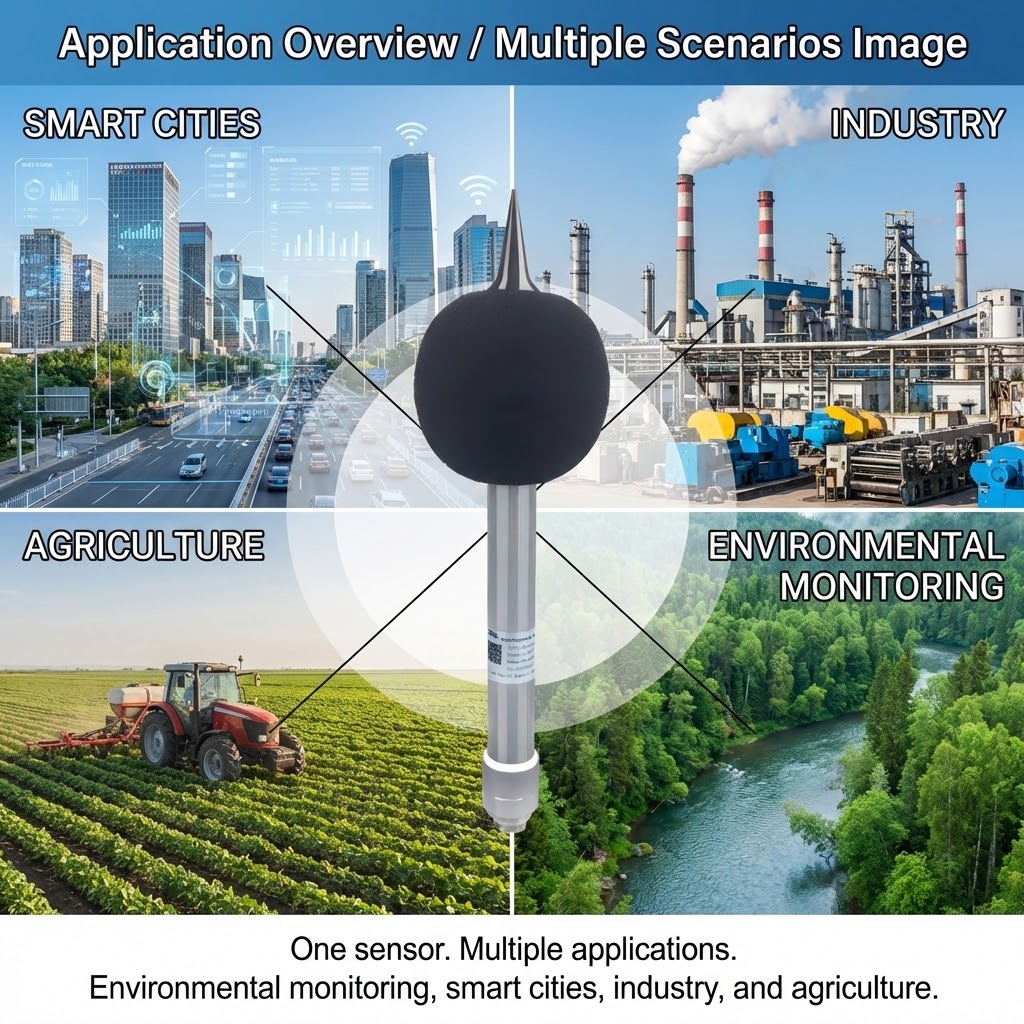
Noise sensors enable cities to create dynamic noise maps that show sound levels across different areas in real time.
Identifies noise hotspots
Tracks changes over time
Supports data-driven urban planning
City authorities can use this data to redesign traffic flow, regulate construction schedules, or implement noise barriers.
Urban planners rely on accurate data to design sustainable cities. Noise sensors provide valuable insights into how different activities impact sound levels.
Zoning decisions (residential vs industrial areas)
Infrastructure development
Traffic management strategies
By integrating noise data with other environmental monitoring parameters, cities can make more balanced and informed decisions.
Noise pollution is directly linked to various health issues. By monitoring and controlling noise levels, cities can improve overall public health.
Reduced stress and sleep disruption
Improved mental well-being
Better quality of life for residents
In smart cities, health-focused policies can be supported by real-time environmental data, including noise levels.
Governments and environmental agencies set limits on acceptable noise levels. Noise sensors help cities enforce these regulations effectively.
Continuous monitoring of compliance zones
Automated alerts when thresholds are exceeded
Reliable data for reporting and audits
This ensures transparency and accountability in urban environmental management.
Noise sensors are often part of a larger environmental monitoring system that includes:
Air quality sensors (PM2.5, PM10, CO₂)
Weather sensors (temperature, humidity, wind)
Light and radiation sensors
Combining multiple data sources provides a holistic view of urban environments. For example, traffic congestion may simultaneously increase both air pollution and noise levels—integrated data helps identify such correlations.
Traffic is one of the biggest contributors to urban noise. Noise sensors help cities optimize transportation systems.
Monitoring noise along highways and busy roads
Evaluating the impact of traffic control measures
Supporting the adoption of quieter transport solutions
This contributes to more efficient and sustainable mobility systems.
Construction is essential for urban growth but can significantly disrupt nearby communities.
Real-time monitoring of construction site noise
Ensuring compliance with permitted working hours
Reducing complaints from residents
In smart city projects, this helps balance development with livability.
Modern cities are increasingly focused on transparency and citizen engagement.
Public access to noise data via apps or dashboards
Increased awareness of environmental conditions
Encouraging community participation in urban planning
When residents can see real-time data, trust in city management improves.
Noise sensors can detect unusual sound patterns, such as explosions, accidents, or sudden disturbances.
Emergency response systems
Public safety monitoring
Event detection in urban areas
This adds another layer of intelligence to smart city infrastructure.
Reducing noise pollution is part of broader sustainability and environmental goals.
Lower environmental impact
Improved urban livability
Alignment with global sustainability standards
Noise sensors help cities move toward greener and more sustainable futures.
Continuous Monitoring: 24/7 data collection without manual intervention
High Accuracy: Reliable measurements for decision-making
Scalability: Easy deployment across large urban areas
IoT Integration: Seamless connection with smart city platforms
Cost Efficiency: Reduced need for manual inspections
While noise sensors offer many advantages, there are also challenges:
Data management and analysis complexity
Sensor calibration and maintenance
Environmental factors affecting accuracy (wind, rain)
Initial deployment costs
However, ongoing advancements in technology are helping overcome these limitations.
The future of noise monitoring in smart cities includes:
AI-powered sound classification (traffic, construction, human activity)
Integration with big data and predictive analytics
Expansion of low-power wireless sensor networks
Greater use of cloud-based platforms
Increased focus on real-time environmental monitoring
As cities become smarter, noise sensors will play an even more central role in urban management.
Noise sensors are transforming how cities understand and manage their environments. By providing real-time, accurate data, they enable more effective urban environmental monitoring and support the development of smarter, healthier cities.
From improving public health and ensuring regulatory compliance to enabling data-driven planning, noise sensors are a vital component of modern smart city ecosystems.
As urbanization continues, investing in intelligent noise monitoring solutions is not just beneficial—it is essential for building sustainable and livable cities.
What are the uses of a rain gauge? Learn how rai
Learn how PAR sensors measure PPFD, optimize gro
Learn how soil EC sensors help optimize fertiliz
Contact: Molly
Phone: +86-17775769236
Tel: 86-0731-85117089
Email: molly@codasensor.com
Add: Building S5, Aux Square, Yuelu District, Changsha City, Hunan Province, China
We chat






 English


