Introduction
Agriculture is entering a new era—one defined by data, automation, and intelligent decision-making. As climate variability increases and global food demand rises, traditional farming methods are no longer sufficient to ensure consistent productivity and sustainability. This is where smart agriculture comes into play.
At the heart of smart agriculture lies the ability to monitor and control environmental conditions with precision. Among the many technologies driving this transformation, CO2 sensors and weather stations stand out as essential tools. Individually, they provide valuable insights. But when combined, they create a powerful system that enables farmers to make better, faster, and more informed decisions.
This article explores how integrating CO2 sensors with weather stations enhances agricultural performance, improves efficiency, and supports sustainable farming practices.
Smart agriculture, also known as precision farming, leverages advanced technologies such as IoT (Internet of Things), cloud computing, and data analytics to optimize farming operations. Instead of relying on intuition or fixed schedules, farmers can now make decisions based on real-time data.
Key objectives of smart agriculture include:
Maximizing crop yield
Reducing resource waste
Improving crop quality
Minimizing environmental impact
To achieve these goals, accurate environmental monitoring is essential—and this is where CO2 sensors and weather stations play a crucial role.
Carbon dioxide (CO2) is a fundamental element in plant growth. It directly influences photosynthesis, the process by which plants produce energy. Without sufficient CO2, even optimal light, water, and nutrients cannot ensure healthy growth.
In controlled environments like greenhouses, CO2 levels can fluctuate rapidly. During daylight hours, plants actively absorb CO2, which can lead to depletion if not replenished. Low CO2 levels result in:
Slower plant growth
Reduced yields
Lower crop quality
By using CO2 sensors, farmers can monitor concentrations in real time and maintain optimal levels—typically between 800 and 1200 ppm for many crops.
High accuracy and stability
Real-time data transmission
Compatibility with IoT platforms
Low maintenance and long lifespan
These features make CO2 sensors an indispensable component of smart agriculture systems.
While CO2 is critical, it is only one piece of the puzzle. Plant growth is influenced by a combination of environmental factors, including temperature, humidity, light, and atmospheric pressure.
A weather station collects and analyzes these parameters, providing a comprehensive overview of environmental conditions.
Air temperature
Relative humidity
Solar radiation
Wind speed and direction
Rainfall
Barometric pressure
This data helps farmers understand both macro (outdoor) and micro (indoor greenhouse) climates, enabling better planning and control.
Using CO2 sensors or weather stations independently provides useful information—but it is the integration of these systems that unlocks their full potential.
When CO2 data is analyzed alongside weather data, farmers gain deeper insights into how environmental factors interact. For example:
Light and CO2 Relationship: Higher light intensity increases photosynthesis, which raises CO2 consumption.
Temperature Impact: Temperature affects plant metabolism and CO2 uptake rates.
Ventilation Effects: Opening vents to regulate temperature can reduce CO2 levels.
Without integrated monitoring, these interactions can lead to inefficiencies or missed opportunities for optimization.
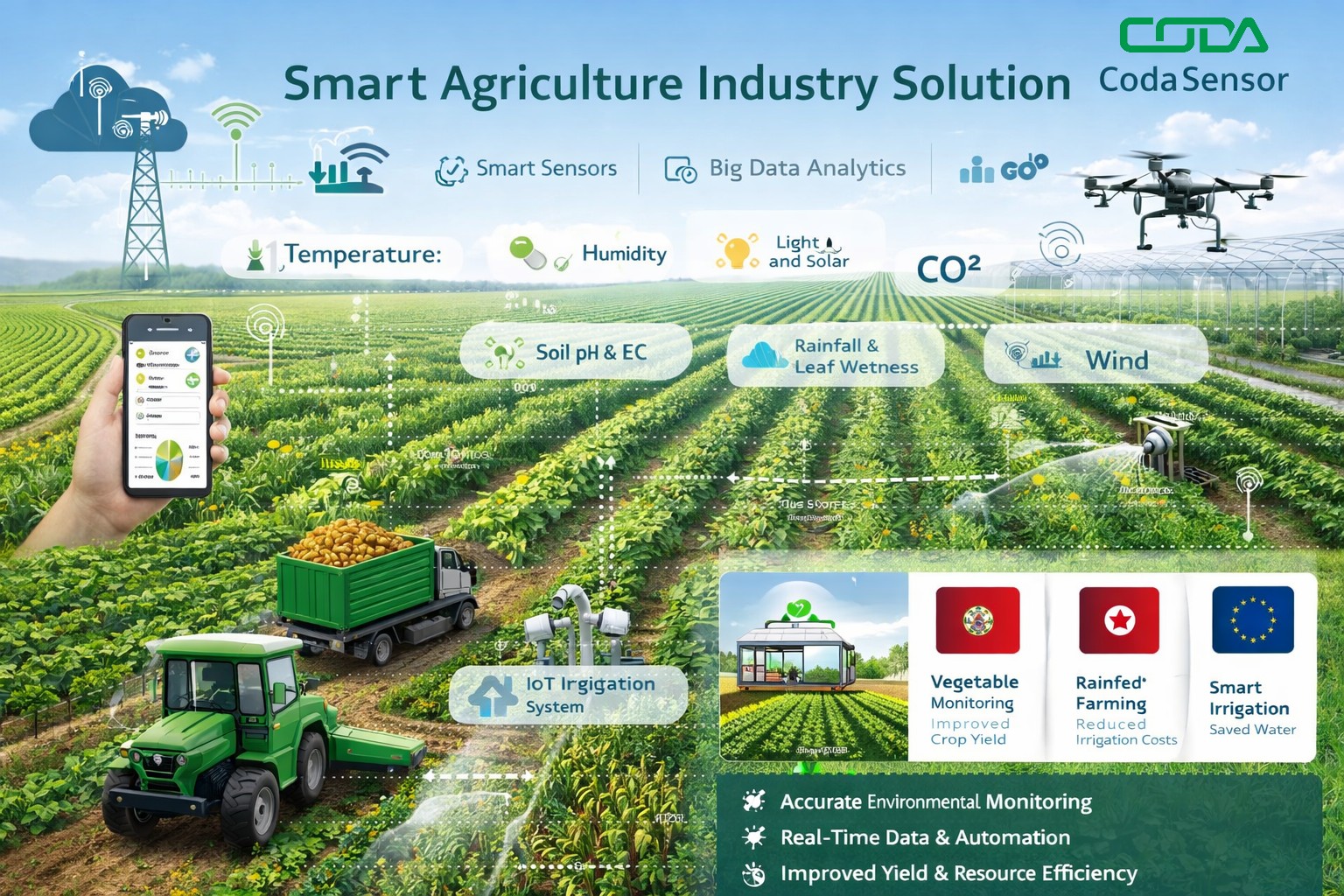 Smart Agriculture CO2 + Weather Station Solution
In greenhouses, maintaining optimal conditions is critical. By combining CO2 sensors with weather stations, farmers can:
Automatically adjust CO2 enrichment systems
Optimize ventilation without losing CO2 efficiency
Maintain ideal growth conditions throughout the day
This results in higher yields and better-quality produce.
Even in open fields, CO2 and weather data can be valuable. Weather stations provide insights into climate patterns, while CO2 data can support research and advanced crop modeling.
Farmers can use this information to:
Optimize planting schedules
Improve irrigation strategies
Anticipate environmental stress factors
Weather data (temperature, humidity, rainfall) combined with plant activity (influenced by CO2 levels) allows for more precise irrigation. This reduces water waste and ensures crops receive the right amount of moisture.
For crops such as strawberries, tomatoes, and flowers, small environmental changes can have a significant impact on quality. Integrated monitoring ensures consistent conditions, leading to premium-grade products.
Farmers no longer need to rely on guesswork. Real-time data enables precise adjustments and informed decisions.
Optimizing CO2 levels alongside environmental conditions enhances photosynthesis and plant growth.
Better control of irrigation, fertilization, and CO2 enrichment reduces waste and lowers costs.
Integrated systems can automate complex processes, reducing the need for manual intervention.
Early detection of unfavorable conditions helps prevent crop loss and ensures consistent production.
Efficient resource use and reduced emissions contribute to environmentally friendly farming practices.
A typical smart agriculture system combining CO2 sensors and weather stations includes:
Sensors Layer
CO2 sensors
Temperature and humidity sensors
Light sensors
Data Transmission Layer
Wireless communication (LoRa, WiFi, 4G/5G)
Cloud Platform
Data storage and analysis
Visualization dashboards
Control Systems
Ventilation systems
Irrigation systems
CO2 generators
User Interface
Mobile apps
Web dashboards
This architecture enables seamless monitoring, analysis, and control.
To maximize the benefits of integrated systems, consider the following:
Install sensors at crop canopy level and in representative locations.
Regularly calibrate sensors to ensure accuracy.
Use a unified platform to analyze all environmental data.
Set specific thresholds based on crop type and growth stage.
Leverage real-time data and alerts to respond quickly to changes.
The integration of CO2 sensors and weather stations is just the beginning. Future developments in smart agriculture include:
Predictive models will optimize environmental conditions automatically.
Virtual models of farms will simulate different scenarios for better planning.
Faster data processing directly on-site for real-time decision-making.
Use of recycled or captured CO2 to reduce environmental impact.
Smart agriculture is transforming the way we grow food, and data is at the center of this revolution. By combining CO2 sensors with weather stations, farmers gain a comprehensive understanding of their environment—enabling smarter decisions, higher yields, and more efficient operations.
This integrated approach not only improves productivity but also supports sustainability and resilience in the face of climate challenges. As technology continues to evolve, the synergy between CO2 monitoring and environmental sensing will become even more critical.
For farmers and agricultural businesses looking to stay competitive, adopting these smart solutions is no longer optional—it is essential.
What are the uses of a rain gauge? Learn how rai
Learn how PAR sensors measure PPFD, optimize gro
Learn how soil EC sensors help optimize fertiliz
Contact: Molly
Phone: +86-17775769236
Tel: 86-0731-85117089
Email: molly@codasensor.com
Add: Building S5, Aux Square, Yuelu District, Changsha City, Hunan Province, China
We chat






 English


