Introduction: Urban Noise Pollution — The Invisible Smart City Challenge
Urbanization has transformed cities into engines of economic growth and innovation—but it has also introduced a less visible yet deeply impactful problem: urban noise pollution. From traffic congestion and construction activity to nightlife districts and mass events, excessive noise has become one of the most widespread environmental stressors in modern cities.
According to the World Health Organization, prolonged exposure to environmental noise contributes to sleep disorders, cardiovascular disease, reduced productivity, and lower overall quality of life. Yet unlike air or water pollution, noise has historically been difficult to measure, regulate, and manage in real time.
This is changing rapidly with the rise of noise sensors as a core component of smart cities. Powered by IoT sensors, real-time data analytics, and acoustic monitoring technologies, modern noise sensor networks provide cities with continuous, objective, and actionable insights into their sound environment.
This article explores the top 10 applications of noise sensors in smart cities, demonstrating how cities worldwide are using noise monitoring not only for compliance, but also to enhance public safety, optimize infrastructure, and design more livable urban environments.
Traffic congestion is one of the primary contributors to urban noise pollution. Traditional traffic monitoring systems rely heavily on cameras or inductive loops, which can be expensive, intrusive, and limited in coverage.
Noise sensors deployed at intersections and road corridors analyze acoustic patterns generated by engines, honking, braking, and acceleration. By correlating sound intensity and frequency with traffic density, cities can infer congestion levels in real time.
Integration approach:
Sensors mounted on streetlights or traffic poles
Data transmitted to a central IoT platform
Combined with AI-based traffic analytics
Dynamic signal timing to reduce idling and stop-and-go noise
Lower congestion-related emissions
Improved commuter experience
Cost-effective alternative to camera-only systems
Most cities lack a continuous, city-wide understanding of where and when noise pollution occurs. Periodic manual measurements provide only fragmented data.
A network of noise sensors enables real-time urban noise mapping, creating dynamic “noise heatmaps” across neighborhoods.
How it works:
Distributed acoustic monitoring points
Continuous decibel and frequency data
Public dashboards updated in real time
Identification of chronic noise hotspots
Transparent data for citizens and policymakers
Evidence-based urban planning decisions
Support for environmental noise regulations (link to local or EU Environmental Noise Directive standards)
Construction is essential for urban development, but it is also a leading source of noise complaints. Manual inspections are inefficient and prone to disputes.
Tamper-resistant noise sensors installed around construction sites automatically monitor sound levels against permitted thresholds and working hours.
Deployment model:
Fixed sensors at site boundaries
Automated alerts when limits are exceeded
Cloud-based compliance reports
Objective, legally defensible evidence
Faster enforcement and dispute resolution
Improved community trust
Reduced project delays due to complaints
Parks, plazas, and recreational areas are intended to offer relief from urban stress—but without monitoring, many become unexpectedly noisy.
Noise monitoring in public spaces provides urban designers with real-world acoustic data to guide planning and management.
Applications include:
Identifying noisy zones within parks
Evaluating effectiveness of sound barriers or vegetation
Managing street performances and vendors
Better-designed, quieter public spaces
Improved citizen well-being
Data-driven enforcement of quiet zones
Higher usage and satisfaction rates
Cities receive thousands of noise complaints annually, often with conflicting claims and limited evidence.
Noise sensors placed in residential areas provide objective, time-stamped acoustic data that can pinpoint the source and duration of disturbances.
Typical sources identified:
Nightclubs and bars
Industrial facilities
HVAC systems
Late-night deliveries
Faster complaint resolution
Reduced administrative burden
Fair enforcement based on data
Improved citizen engagement and trust
Festivals, concerts, protests, and sports events create complex crowd dynamics that can escalate into safety risks if unmanaged.
Acoustic monitoring during large events analyzes crowd noise patterns to infer density, excitement levels, or sudden disturbances.
Integration points:
Temporary sensor deployment
Real-time dashboards for security teams
Integration with CCTV and emergency systems
Early detection of overcrowding
Faster response to incidents
Improved evacuation planning
Enhanced public safety without intrusive surveillance
Critical infrastructure failures are costly, disruptive, and often preventable—but traditional inspections are infrequent and labor-intensive.
Noise sensors detect abnormal acoustic signatures from bridges, railways, tunnels, and industrial equipment, signaling early-stage faults.
Examples of detectable anomalies:
Unusual vibration sounds
Metal fatigue noises
Bearing or motor irregularities
Predictive maintenance instead of reactive repairs
Extended infrastructure lifespan
Reduced downtime and costs
Improved safety for citizens
Street lighting consumes significant energy, yet static lighting levels do not reflect actual street activity.
Lamp-post-mounted noise sensors work alongside motion and light sensors to enable adaptive street lighting.
Smart behavior:
Brighter lighting in noisy, active areas
Dimmed lighting in quiet, low-activity zones
Automatic adjustment based on time and context
Energy savings
Reduced light pollution
Enhanced pedestrian safety
Seamless IoT sensor integration
Schools, hospitals, libraries, and eldercare facilities require controlled acoustic environments, but are often affected by nearby urban activity.
Noise sensors in sensitive zones continuously monitor sound levels and trigger alerts when sustained disruptions occur.
Use cases:
School zones near busy roads
Hospital surroundings
Libraries and research centers
Better learning and healing environments
Faster intervention by authorities
Data-backed zoning and traffic policies
Compliance with health and education standards
Many urban emergencies escalate before authorities are notified, delaying response times.
Advanced acoustic monitoring systems can recognize specific sound events such as:
Gunshots
Glass breaking
Screams or distress signals
System integration:
AI-based sound classification
Instant alerts to law enforcement
Integration with emergency dispatch systems
Faster emergency response
Crime deterrence
Improved situational awareness
Non-intrusive public safety enhancement
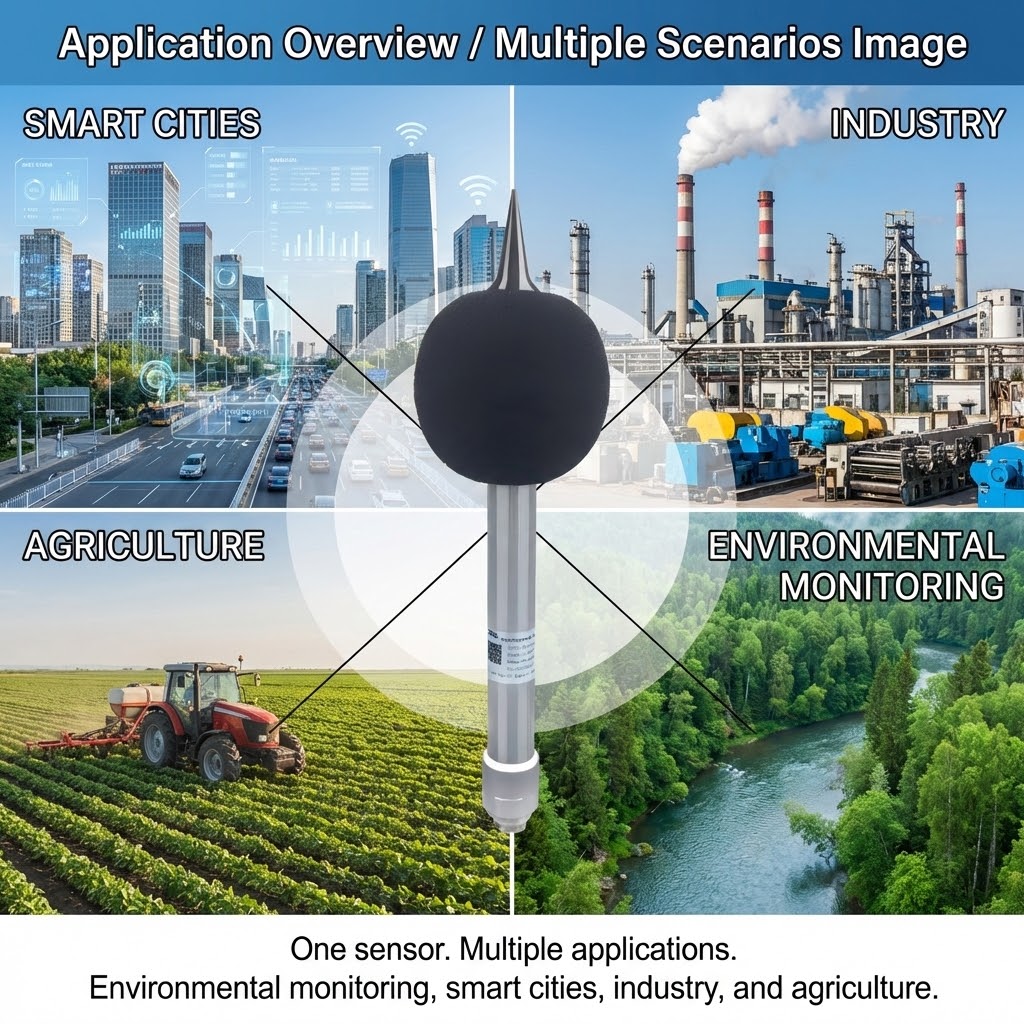
From traffic optimization and infrastructure maintenance to public safety and community well-being, noise sensors have evolved far beyond simple decibel meters. As a core category of IoT sensors, they provide cities with real-time, objective, and actionable data that supports smarter decision-making across departments.
When integrated into broader smart city platforms, noise sensor networks enable:
Proactive urban noise pollution control
Transparent governance
Improved quality of life
More sustainable and efficient cities
Looking ahead, the future of noise monitoring lies in deeper integration with AI, 5G connectivity, and edge computing, allowing cities to move from reactive noise management to predictive, adaptive urban sound design.
For urban planners, IoT solution providers, and environmental consultants, now is the time to explore how noise sensor technology can elevate your next smart city project. Start by evaluating pilot deployments—and let data shape quieter, safer cities.
What are the uses of a rain gauge? Learn how rai
Learn how PAR sensors measure PPFD, optimize gro
Learn how soil EC sensors help optimize fertiliz
Contact: Molly
Phone: +86-17775769236
Tel: 86-0731-85117089
Email: molly@codasensor.com
Add: Building S5, Aux Square, Yuelu District, Changsha City, Hunan Province, China
We chat






 English


