Water quality monitoring plays a crucial role in industries ranging from aquaculture and environmental protection to wastewater treatment and industrial processing. Among all measurable parameters, dissolved oxygen (DO) is one of the most vital indicators of water health.
To accurately measure and manage oxygen levels in water, professionals rely on dissolved oxygen sensors—commonly referred to as DO sensors. These devices provide real-time data that helps maintain optimal conditions for biological activity, chemical processes, and ecosystem balance.
In this complete guide, we will explore what a dissolved oxygen sensor is, how it works, its types, applications, benefits, and how to choose the right one for your needs.
A dissolved oxygen sensor is an electronic device designed to measure the concentration of oxygen dissolved in water or other liquids. The measurement is typically expressed in:
Milligrams per liter (mg/L)
Parts per million (ppm)
Percentage saturation (%)
DO sensors are essential tools in any system where oxygen levels influence performance, safety, or biological processes.
Dissolved oxygen is critical because it directly affects:
Fish, shrimp, and other aquatic organisms rely on oxygen for respiration. Low DO levels can lead to stress, disease, or death.
In wastewater treatment, microorganisms use oxygen to break down organic matter. Insufficient oxygen reduces treatment efficiency.
Oxygen levels influence oxidation-reduction reactions, corrosion rates, and nutrient cycles in water systems.
DO is a key indicator of ecosystem health in rivers, lakes, and oceans. Sudden drops can signal pollution or algal blooms.
DO sensors measure oxygen using two main technologies: electrochemical and optical.
Electrochemical sensors are the traditional and widely used type. They measure oxygen through a chemical reaction that generates an electrical signal.
Require a constant voltage
Oxygen diffuses through a membrane and is reduced at the cathode
Generate a current proportional to oxygen concentration
Self-powered (no external voltage required)
Use two electrodes to produce a current when oxygen is present
Faster response time than polarographic sensors
Cost-effective
Reliable for many applications
Require regular maintenance (membrane and electrolyte replacement)
Sensitive to flow conditions
Optical sensors use light-based technology to measure oxygen levels.
A luminescent material is exposed to blue light
Oxygen affects the intensity or lifetime of emitted light
The sensor calculates oxygen concentration based on this change
High accuracy and stability
Minimal maintenance
No oxygen consumption during measurement
Less affected by flow conditions
Higher initial cost
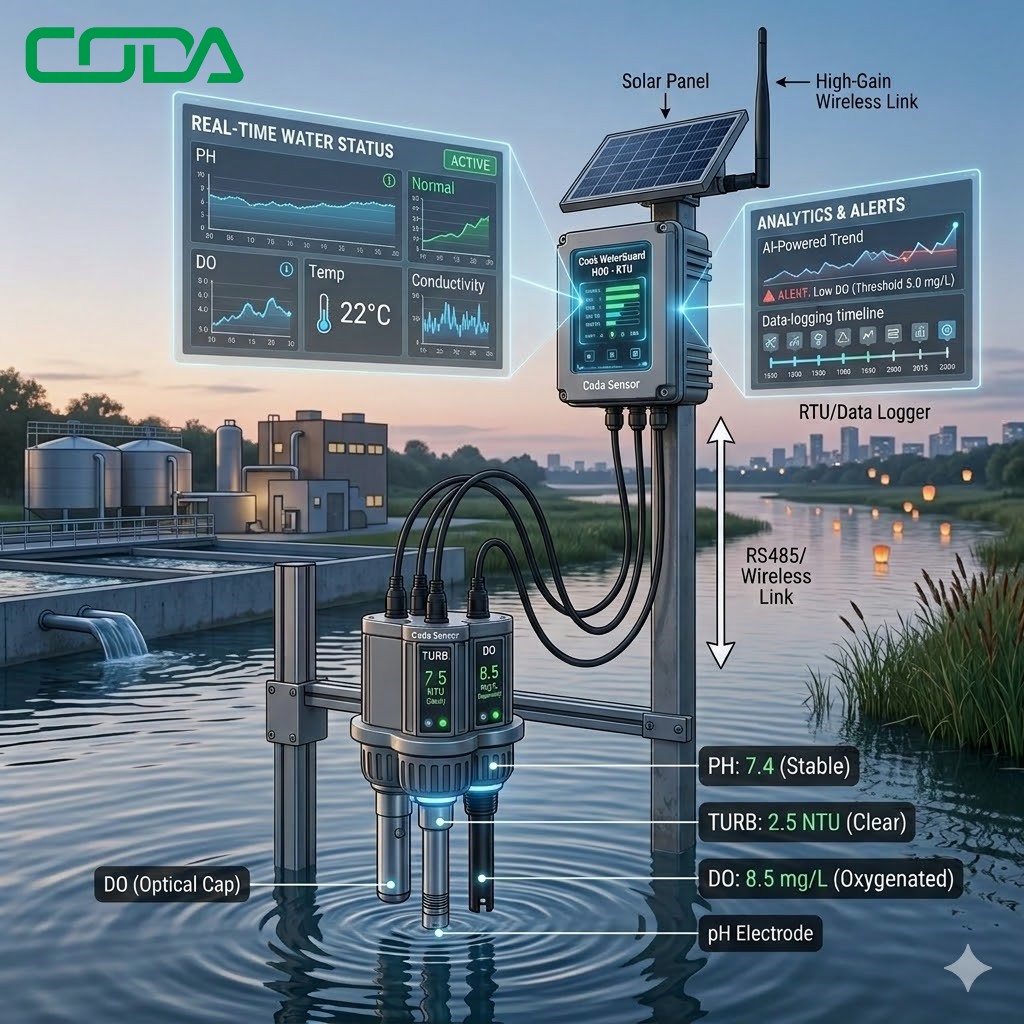
A complete DO monitoring system typically includes:
The part that directly interacts with water and measures oxygen levels.
Converts sensor signals into readable data and may control other systems.
Shows real-time readings and allows user interaction.
Enables integration with SCADA, IoT platforms, or cloud systems for remote monitoring.
DO sensors are essential in fish farming and shrimp cultivation.
Key roles:
Monitoring oxygen levels in ponds and tanks
Controlling aeration systems
Preventing fish mortality
Optimizing feeding and growth
In wastewater plants, DO sensors ensure efficient biological treatment.
Key roles:
Monitoring aeration tanks
Controlling oxygen supply
Reducing energy consumption
Maintaining compliance with environmental standards
DO sensors are used in rivers, lakes, and coastal areas to assess ecosystem health.
Key roles:
Detecting pollution events
Monitoring seasonal changes
Supporting environmental research
Industries such as food processing, pharmaceuticals, and power generation use DO sensors.
Key roles:
Monitoring process water
Controlling chemical reactions
Preventing corrosion in boilers and cooling systems
DO sensors help maintain water quality in distribution systems.
Key roles:
Monitoring oxygen levels to prevent bacterial growth
Ensuring safe and clean water supply
Continuous data allows immediate response to changes in oxygen levels.
Optimizing oxygen levels improves biological and chemical processes.
Reducing unnecessary aeration lowers energy consumption.
Preventing oxygen depletion protects aquatic life and system stability.
Accurate data supports better operational planning and control.
Regular calibration ensures measurement accuracy.
Common methods:
Air calibration (100% saturation)
Zero oxygen calibration using chemical solutions
Clean the sensor regularly to remove fouling
Replace membranes and electrolytes (for electrochemical sensors)
Inspect optical caps (for optical sensors)
Verify readings periodically
Proper maintenance extends sensor lifespan and ensures reliable performance.
Aquaculture, wastewater, or industrial use
Freshwater or seawater
High-precision applications may require optical sensors.
Optical sensors are better for low-maintenance operations.
Electrochemical sensors are more affordable upfront.
Ensure compatibility with existing monitoring systems or IoT platforms.
Fast response is critical in dynamic environments like aquaculture.
Modern DO sensors are increasingly integrated with IoT and automation systems.
Remote monitoring via cloud platforms
Real-time alerts and notifications
Data analytics and trend analysis
Automated control of aeration systems
This integration enables smarter, more efficient water management.
Solution: Regular cleaning and anti-fouling coatings
Solution: Routine calibration
Solution: Use sensors with automatic temperature compensation
Solution: Proper placement to ensure representative measurements
Enabling flexible deployment and easy installation
Combining DO with pH, temperature, turbidity, and more
Predicting oxygen demand and optimizing system performance
Supporting long-term remote monitoring applications
Dissolved oxygen sensors are fundamental tools for modern water quality monitoring. By providing accurate, real-time data, they enable better control of biological processes, improve efficiency, and support sustainable operations across multiple industries.
Whether in aquaculture, wastewater treatment, or environmental monitoring, DO sensors help maintain the delicate balance required for healthy and efficient systems.
As technology continues to evolve, DO sensors will become even smarter, more reliable, and more integrated—making them an essential investment for anyone involved in water management.
What are the uses of a rain gauge? Learn how rai
Learn how PAR sensors measure PPFD, optimize gro
Learn how soil EC sensors help optimize fertiliz
Contact: Molly
Phone: +86-17775769236
Tel: 86-0731-85117089
Email: molly@codasensor.com
Add: Building S5, Aux Square, Yuelu District, Changsha City, Hunan Province, China
We chat






 English


