As the global solar energy industry continues to expand rapidly, photovoltaic (PV) power plants are becoming increasingly intelligent and data-driven. Modern solar farms are no longer limited to simply generating electricity; they now rely heavily on real-time monitoring systems to maximize efficiency, reduce operational costs, and improve long-term reliability.
One of the most important technologies supporting this transformation is the Solar SCADA system. SCADA, which stands for Supervisory Control and Data Acquisition, enables operators to remotely monitor and control solar power plants through centralized software platforms.
However, the effectiveness of any solar SCADA system depends heavily on the accuracy of the field data it receives. Among all environmental and operational parameters, PV panel temperature is one of the most critical variables affecting solar power generation performance.
This is why accurate PV panel temperature sensors are essential for modern solar SCADA systems.
In this article, we will explore the role of PV panel temperature monitoring, how it impacts solar plant efficiency, why accurate sensors matter, and how intelligent temperature monitoring improves the performance and safety of photovoltaic systems.
A Solar SCADA system is an advanced monitoring and control platform designed specifically for photovoltaic power plants. It collects data from multiple devices across the solar installation, including:
Inverters
Combiner boxes
Energy meters
String monitoring systems
The SCADA platform processes this information in real time and provides operators with visual dashboards, alarms, analytics, and performance reports.
The main objectives of a Solar SCADA system include:
Maximizing energy production
Detecting faults quickly
Improving operational efficiency
Supporting preventive maintenance
Reducing downtime
Ensuring plant safety
Calculating accurate performance ratios (PR)
Among all monitored parameters, module temperature plays a direct role in determining solar panel efficiency.
Solar panels convert sunlight into electricity through photovoltaic cells. However, solar panels do not operate most efficiently under extremely high temperatures.
In fact, when PV module temperature rises, the electrical efficiency of the panel decreases.
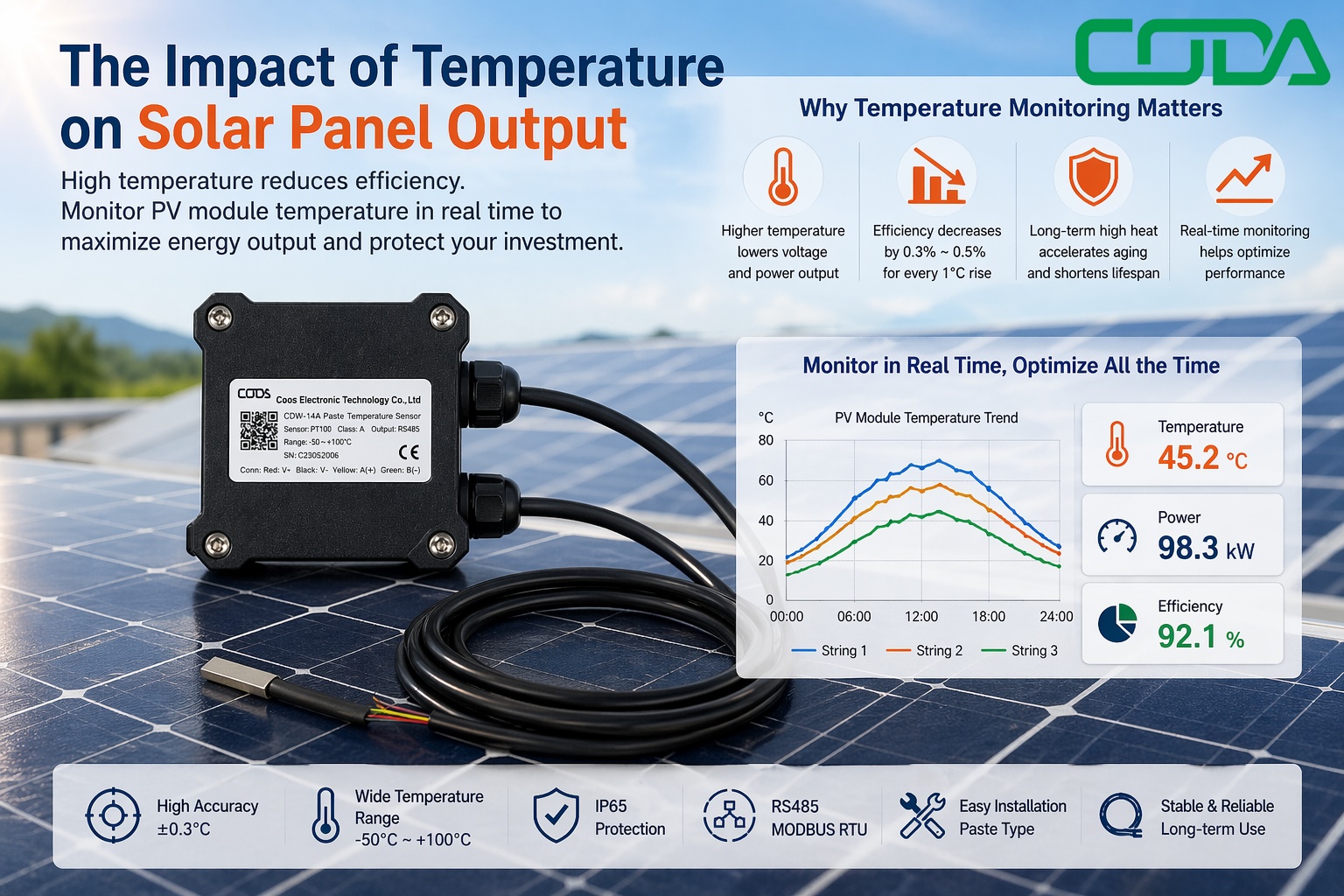
Most solar panels are rated under Standard Test Conditions (STC), which assume a cell temperature of 25°C. In real-world environments, especially in hot climates, panel temperatures can easily exceed 60°C or even 80°C.
As temperature increases:
Voltage decreases
Power output drops
System efficiency declines
Long-term material degradation accelerates
For many solar modules, power loss is approximately 0.3% to 0.5% per °C above 25°C.
This means that if panel temperature rises from 25°C to 65°C, the system could lose a significant percentage of its expected output.
Because of this direct relationship between temperature and power generation, accurate temperature monitoring becomes essential for performance analysis and operational decision-making.
PV panel temperature sensors are designed to measure the actual surface or backside temperature of solar modules.
These sensors are typically installed directly on the PV panel using thermal adhesive, brackets, or mounting clips to ensure accurate thermal contact.
The measured temperature data is then transmitted to the SCADA system through:
RS485 communication
Modbus RTU protocol
Analog signals
Wireless IoT transmission
Data loggers
Remote telemetry systems
The SCADA platform uses this data to:
Calculate real-time efficiency
Compare expected vs actual power generation
Detect abnormal temperature rises
Trigger alarms
Support predictive maintenance
Analyze plant performance trends
Without accurate temperature measurements, solar operators may receive misleading performance data and fail to identify hidden operational issues.
Performance Ratio (PR) is one of the most important indicators used in solar plant evaluation.
PR measures how efficiently a solar plant converts available solar irradiance into usable electrical energy.
However, temperature directly affects module efficiency. If temperature data is inaccurate, PR calculations become unreliable.
For example:
A faulty sensor may under-report module temperature
The SCADA system may assume the panels should produce more power
Operators may incorrectly suspect inverter or module failures
Accurate PV temperature sensors ensure the SCADA system uses correct compensation values when evaluating plant performance.
This helps operators make smarter maintenance decisions and avoid unnecessary troubleshooting.
Abnormal temperature increases often indicate developing problems inside the solar array.
Common issues include:
Hot spots
Cell mismatch
Loose electrical connections
Damaged modules
Shading problems
Dirt accumulation
Bypass diode failures
If one section of a solar panel becomes significantly hotter than surrounding modules, it may indicate internal electrical resistance or damage.
Accurate temperature sensors integrated into SCADA systems can trigger alarms when unusual thermal conditions occur.
This allows maintenance teams to respond before severe damage or energy losses occur.
Early fault detection reduces:
Maintenance costs
Fire risks
Equipment failure
System downtime
Solar investors and plant operators rely heavily on yield analysis to evaluate project profitability.
SCADA systems compare actual energy generation against expected production models.
However, expected output calculations must consider real module temperature.
Without precise temperature measurements:
Energy models become inaccurate
Financial forecasts may be misleading
Underperformance may go unnoticed
Accurate PV panel temperature sensors help improve:
Yield forecasting
ROI calculations
O&M planning
Asset management strategies
This is particularly important for utility-scale solar farms where even small efficiency improvements can generate substantial financial benefits.
Modern solar plants increasingly rely on predictive and preventive maintenance strategies.
Instead of waiting for failures to occur, operators use sensor data to identify potential problems in advance.
Temperature monitoring is a key part of this approach.
By continuously tracking panel temperatures, SCADA systems can identify:
Gradual overheating trends
Seasonal performance changes
Environmental stress
Cooling airflow issues
Module aging
This allows operators to schedule maintenance proactively rather than reactively.
Preventive maintenance helps extend equipment lifespan and improve long-term system stability.
Excessive temperatures in solar installations can create serious safety hazards.
Potential risks include:
Electrical fires
Arc faults
Connector melting
Cable overheating
Thermal runaway
Accurate temperature sensors help SCADA systems detect dangerous thermal conditions before they escalate.
Automatic alarms and remote notifications enable operators to respond quickly.
In large utility-scale projects, this level of monitoring is critical for protecting:
Personnel
Equipment
Infrastructure
Investment assets
Not all temperature sensors provide the same level of precision.
Low-quality or poorly calibrated sensors may suffer from:
Drift
Slow response time
Environmental interference
Poor thermal contact
Signal instability
Even small temperature measurement errors can significantly affect SCADA analytics.
For example:
A measurement error of just 5°C may result in incorrect efficiency calculations, false alarms, or inaccurate performance benchmarking.
High-quality PV panel temperature sensors typically offer:
High accuracy
Fast thermal response
UV-resistant materials
Waterproof protection
Stable long-term performance
Wide operating temperature ranges
Reliable industrial communication protocols
For harsh outdoor environments, industrial-grade sensors are essential.
When selecting temperature sensors for Solar SCADA applications, operators should consider the following features:
Accurate data is the foundation of effective SCADA analysis.
Rapid response helps identify sudden temperature changes quickly.
Outdoor solar installations require IP65/IP67 waterproof protection and UV-resistant materials.
Sensors should maintain calibration stability over many years.
Simple mounting methods reduce installation time and labor costs.
Sensors should support standard industrial communication protocols such as:
RS485
Modbus RTU
4-20mA
Analog voltage output
PV panel temperature sensors are widely used in:
Large solar power stations require centralized SCADA monitoring across thousands of panels.
Commercial and industrial rooftop projects use temperature monitoring for performance optimization.
Temperature data supports intelligent energy management in solar-storage hybrid systems.
Universities and laboratories use precise temperature monitoring for photovoltaic research and testing.
Integrated renewable infrastructure relies on accurate environmental sensing and SCADA automation.
The future of solar monitoring is becoming increasingly intelligent.
Emerging technologies include:
AI-powered fault prediction
IoT-enabled wireless sensors
Cloud-based SCADA platforms
Digital twin technology
Big data analytics
Edge computing
As solar plants become smarter, accurate field data will become even more important.
PV panel temperature sensors will continue playing a critical role in:
Automated diagnostics
Intelligent maintenance
Performance optimization
Remote asset management
High-quality sensor integration will become a standard requirement for modern photovoltaic projects.
Solar SCADA systems are the digital backbone of modern photovoltaic power plants. Their ability to maximize efficiency, reduce downtime, and improve operational reliability depends entirely on the quality of the data they receive.
Among all environmental monitoring parameters, PV panel temperature is one of the most influential factors affecting solar performance.
Accurate PV panel temperature sensors enable SCADA systems to:
Calculate true system efficiency
Detect faults early
Improve preventive maintenance
Enhance plant safety
Optimize energy production
Increase long-term profitability
As the solar industry continues evolving toward smarter and more automated energy systems, reliable temperature monitoring will remain an essential component of successful solar plant operations.
Investing in high-quality PV panel temperature sensors is not simply about collecting data — it is about protecting assets, improving performance, and maximizing the return on solar energy investments.
PV panel temperature directly affects solar panel efficiency. Higher temperatures reduce power output and may indicate system faults.
It measures the actual operating temperature of solar modules and sends the data to the SCADA system for monitoring and analysis.
As temperature rises, solar panel voltage decreases, causing lower power generation efficiency.
Common outputs include RS485, Modbus RTU, 4-20mA, and analog voltage signals.
Yes. Accurate temperature monitoring can detect overheating, hot spots, and abnormal operating conditions before serious failures occur.
What are the uses of a rain gauge? Learn how rai
Learn how PAR sensors measure PPFD, optimize gro
Learn how soil EC sensors help optimize fertiliz
Contact: Molly
Phone: +86-17775769236
Tel: 86-0731-85117089
Email: molly@codasensor.com
Add: Building S5, Aux Square, Yuelu District, Changsha City, Hunan Province, China
We chat






 English


