Light is one of the most important factors influencing plant growth. Through photosynthesis, plants convert light energy into chemical energy, supporting leaf development, flowering, fruit production, and overall crop quality.
For thousands of years, farmers have depended on natural sunlight. However, with the rapid development of smart agriculture, greenhouse farming, and vertical farming, artificial lighting has become an essential tool for year-round crop production.
Modern growers can now control:
Light intensity
Lighting duration
Light spectrum
Growing cycles
through advanced LED grow lights.
However, one challenge remains:
How can growers know whether plants are receiving the correct amount of usable light?
The answer is PAR sensors and PPFD monitoring technology.
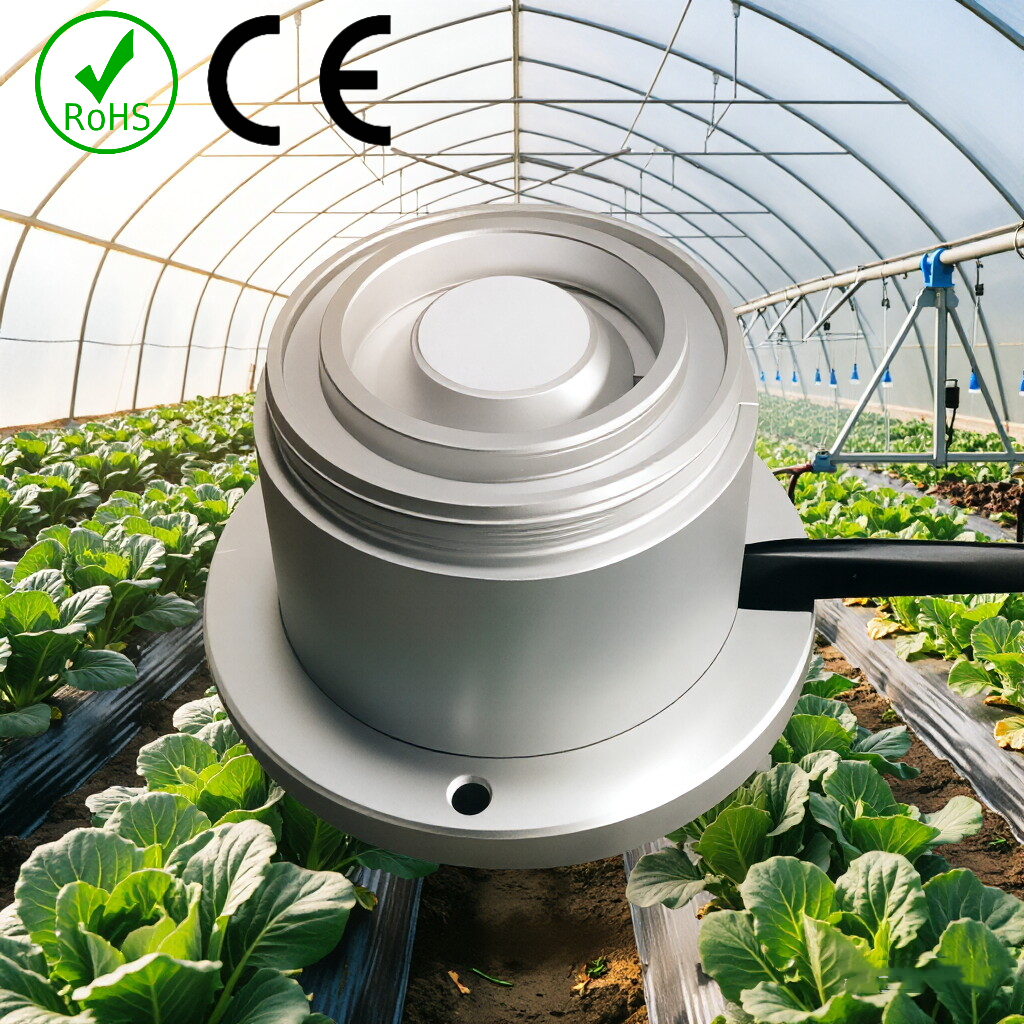
A PAR sensor measures the amount of photosynthetically active light reaching plants, helping growers optimize grow light systems, reduce energy waste, and improve crop productivity.
PAR stands for Photosynthetically Active Radiation.
It refers to the wavelength range of light that plants use for photosynthesis:
400–700 nanometers (nm)
Within this range, plants absorb photons through photosynthetic pigments such as chlorophyll.
Different wavelengths have different effects:
Blue light plays an important role in:
Leaf development
Plant structure
Root growth
Compact plant formation
Red light supports:
Photosynthesis efficiency
Flowering
Fruit production
Biomass accumulation
Because plants respond differently to various wavelengths, professional growers need to monitor not only the presence of light but also the quantity of usable light.
This leads to the importance of PPFD measurement.
PPFD stands for:
Photosynthetic Photon Flux Density
It measures the number of PAR photons reaching a specific surface area every second.
The measurement unit is:
μmol/m²/s
Unlike traditional light measurements such as lux, PPFD focuses specifically on photons that plants can use for photosynthesis.
For plant growth, PPFD provides a more accurate indication of whether lighting conditions are suitable.
For example:
A grow lamp may appear bright to human eyes, but plants may still receive insufficient photosynthetic light.
A PAR sensor can accurately measure:
Light intensity at canopy level
Light distribution across growing areas
Changes caused by plant growth
Performance of LED lighting systems
A grow light provides artificial illumination, while a PAR sensor measures its effectiveness.
The relationship can be explained as:
LED Grow Light → Produces Photons → PAR Sensor Measures PPFD → Data Analysis → Lighting Adjustment
This creates a closed-loop smart farming system.
With PPFD data, growers can decide:
Should the lights be brighter?
Should lighting hours be increased?
Are plants receiving too much light?
Is the light distribution uniform?
Without PPFD measurement, growers often adjust lighting based on experience or visual observation, which can lead to:
Higher electricity costs
Uneven plant growth
Reduced crop quality
Many growers select lighting systems based on electrical power:
200W LED light
500W LED light
1000W LED light
However, wattage only indicates energy consumption.
It does not tell growers how much usable light reaches plants.
Two LED lights with the same power rating may produce different PPFD values due to:
Newer LED technologies can generate more photons using less electricity.
Different crops require different spectral combinations.
The distance between the lamp and plants directly affects PPFD.
Walls and greenhouse structures influence light distribution.
Large farms require uniform light coverage.
Therefore, measuring PPFD is much more meaningful than simply looking at lamp power.
Different crops have different lighting requirements.
Providing the correct PPFD range helps plants achieve maximum photosynthetic efficiency.
Examples:
Lettuce
Spinach
Kale
Pak choi
Recommended PPFD:
100–300 μmol/m²/s
Leafy vegetables usually have lower light requirements.
Excessive lighting may cause:
Leaf stress
Higher energy costs
Reduced production efficiency
For indoor farms, maintaining stable PPFD helps improve:
Leaf size
Color
Growth speed
Harvest consistency
Examples:
Basil
Mint
Parsley
Cilantro
Recommended PPFD:
150–400 μmol/m²/s
Herbs require moderate light levels.
Proper PPFD management can improve:
Aroma
Leaf density
Plant strength
Recommended PPFD:
400–800 μmol/m²/s
Tomatoes are considered high-light crops.
Higher PPFD supports:
Faster growth
Better flowering
Higher fruit production
Increased sugar content
However, high light levels should be combined with:
Proper CO₂ concentration
Temperature control
Water management
Otherwise, plants may experience stress.
Recommended PPFD:
400–700 μmol/m²/s
Cucumbers grow rapidly and require strong illumination.
Optimized PPFD improves:
Leaf expansion
Flower development
Fruit formation
Recommended PPFD:
300–600 μmol/m²/s
Strawberries benefit from consistent light exposure.
Proper lighting management helps improve:
Fruit size
Sweetness
Flower production
Examples:
Flowering ornamentals
Certain fruiting plants
Recommended PPFD:
500–900 μmol/m²/s
Higher PPFD supports:
Flower formation
Strong plant structure
Increased yield potential
Plants require different light levels throughout their lifecycle.
Recommended PPFD:
100–300 μmol/m²/s
Purpose:
Encourage healthy development
Avoid excessive stress
Recommended PPFD:
300–600 μmol/m²/s
Purpose:
Promote leaf growth
Build plant structure
Recommended PPFD:
600–1000 μmol/m²/s
Purpose:
Maximize production
Improve fruit quality
More light does not always mean better growth.
When PPFD exceeds plant requirements:
Photosynthesis reaches saturation
Leaves may become damaged
Energy is wasted
PAR sensors help maintain optimal lighting conditions.
Large greenhouses and vertical farms often have uneven lighting.
PAR sensors can identify:
Low-light areas
Excessive light zones
Uneven crop conditions
This allows growers to adjust:
Lamp positions
Light intensity
Installation height
Lighting is one of the largest expenses in indoor farming.
By monitoring PPFD, growers can:
Reduce unnecessary lighting
Adjust LED brightness
Optimize operating schedules
This improves both productivity and profitability.
Modern agricultural systems increasingly combine multiple sensors.
A complete smart greenhouse monitoring system may include:
PAR sensor
Temperature sensor
Humidity sensor
Soil moisture sensor
Soil temperature sensor
EC sensor
Real-time monitoring
Historical data analysis
Remote control
By integrating these technologies, growers can create automated cultivation environments.
For example:
When PPFD is too low:
→ Increase grow light intensity
When PPFD is sufficient:
→ Reduce lighting power to save energy
This creates a more efficient and sustainable agricultural model.
The future of agriculture is moving toward precision management.
Instead of asking:
"How powerful should my grow light be?"
Farmers will ask:
"How much usable light are my plants receiving?"
With PAR sensors, artificial intelligence, and IoT platforms, growers can optimize:
Crop growth cycles
Energy consumption
Production quality
Resource efficiency
Smart lighting management will become a critical technology for:
Vertical farms
Commercial greenhouses
Indoor cultivation facilities
Research farms
Grow lights provide artificial energy for plants, but PAR sensors provide the data needed to use that energy efficiently.
By measuring PPFD, growers can understand the real lighting conditions at the plant level and make accurate decisions.
Different crops require different PPFD levels:
Leafy greens: 100–300 μmol/m²/s
Herbs: 150–400 μmol/m²/s
Strawberries: 300–600 μmol/m²/s
Tomatoes: 400–800 μmol/m²/s
High-light crops: 500–900+ μmol/m²/s
The combination of PAR sensors + smart grow lights + IoT monitoring creates a more efficient, precise, and sustainable future for agriculture.
Measure the light. Optimize the growth. Maximize the harvest.
What are the uses of a rain gauge? Learn how rai
Learn how PAR sensors measure PPFD, optimize gro
Learn how soil EC sensors help optimize fertiliz
Contact: Molly
Phone: +86-17775769236
Tel: 86-0731-85117089
Email: molly@codasensor.com
Add: Building S5, Aux Square, Yuelu District, Changsha City, Hunan Province, China
We chat






 English


