In modern industrial environments, reliable data transmission is essential for efficient monitoring and automation. From weather stations and smart agriculture to industrial factories and environmental monitoring systems, sensors must operate accurately even in harsh conditions with long communication distances and electromagnetic interference.
This is where RS485 sensors play a critical role.
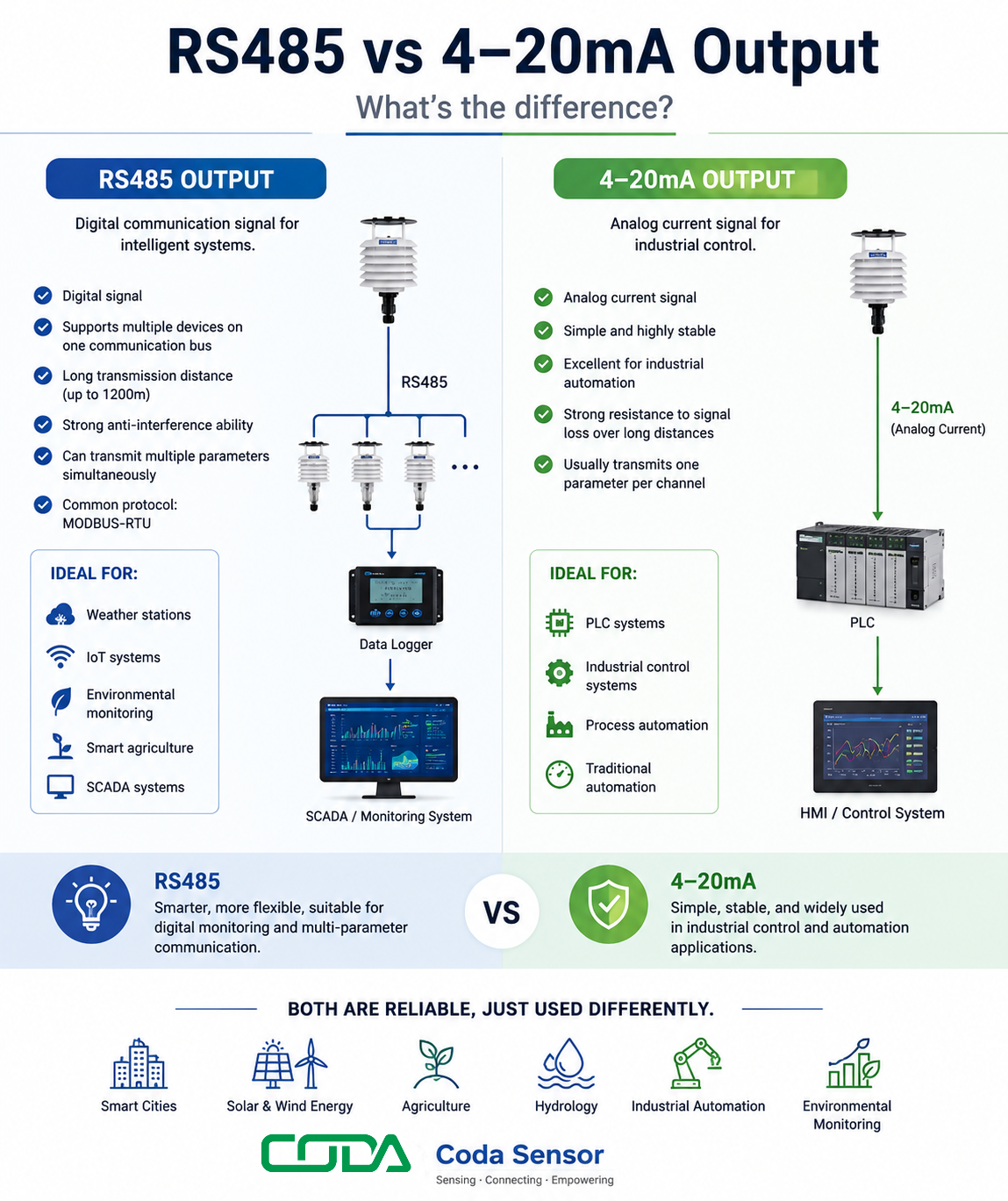
Compared with traditional analog sensors or short-distance communication methods, RS485 sensors offer superior stability, anti-interference capability, and long-range communication performance. When combined with Modbus RTU protocol, they become one of the most widely used solutions for industrial monitoring systems worldwide.
In this article, we will explore how RS485 sensors improve industrial monitoring reliability, their core advantages, common applications, integration methods, and real-world project cases.
An RS485 sensor is a digital sensor that uses the RS485 communication standard to transmit data between devices. RS485 is a differential serial communication protocol designed specifically for industrial environments.
Unlike analog output sensors that transmit voltage or current signals, RS485 sensors send digital data directly, reducing signal distortion and improving communication reliability.
RS485 technology is commonly used in:
Industrial automation
Smart agriculture
Weather stations
Building automation
Solar power monitoring systems
Many industrial sensors today also support Modbus RTU protocol over RS485, allowing seamless integration with PLCs, data loggers, SCADA systems, and cloud monitoring platforms.
Industrial monitoring systems often operate in complex environments where communication stability is critical.
Challenges include:
Long cable distances
Strong electromagnetic interference
High-voltage equipment nearby
Outdoor weather exposure
Multiple sensors connected simultaneously
Remote installation locations
Traditional analog communication methods may suffer from:
Signal attenuation
Noise interference
Voltage drops
Calibration drift
Data inaccuracies
RS485 technology was specifically developed to overcome these issues.
One of the biggest advantages of RS485 sensors is their ability to support long-distance communication.
Typical RS485 communication distances can reach:
Up to 1200 meters under standard conditions
Stable performance over long cable runs
Reduced signal degradation compared to analog outputs
This makes RS485 ideal for:
Large factories
Solar farms
Smart agriculture projects
Highway monitoring
Tunnel monitoring
Distributed environmental monitoring stations
For example, in a photovoltaic power station, weather sensors may be installed hundreds of meters away from the control room. RS485 communication ensures stable data transmission without requiring expensive signal repeaters.
Long-distance capability helps reduce:
Installation costs
Wiring complexity
Maintenance requirements
Additional communication hardware
It also improves system scalability for future expansion.
Industrial environments are full of electromagnetic interference sources, including:
Motors
Inverters
Pumps
Power cables
High-voltage equipment
Radio frequency devices
RS485 uses differential signal transmission, which significantly improves noise immunity.
RS485 transmits data using two signal lines:
A+
B-
The receiving device measures the voltage difference between these lines rather than relying on a single signal referenced to ground.
This design helps eliminate common-mode noise and external interference.
More accurate sensor data
Reduced communication errors
Improved system stability
Lower maintenance frequency
Better performance in harsh industrial environments
This is especially important for outdoor monitoring stations exposed to lightning, power fluctuations, and industrial equipment.
Another major advantage of RS485 is that multiple sensors can share the same communication bus.
A single RS485 network can connect:
Temperature sensors
Humidity sensors
Wind sensors
Each device has its own communication address, allowing centralized monitoring and control.
Reduced wiring costs
Simplified installation
Easier maintenance
Better scalability
Centralized data management
This architecture is widely used in:
Smart greenhouses
Building automation
Industrial production lines
Environmental monitoring systems
Most RS485 industrial sensors support Modbus RTU protocol, one of the most popular industrial communication protocols worldwide.
Modbus RTU allows different devices from different manufacturers to communicate using standardized commands.
RS485 Modbus sensors can easily connect with:
Siemens PLC
Schneider PLC
Mitsubishi PLC
Allen-Bradley PLC
Delta PLC
They can also integrate with:
SCADA systems
HMI displays
Industrial gateways
IoT cloud platforms
New sensors can be added without redesigning the entire communication system.
RS485 sensors are widely used for:
Air quality monitoring
Smart city monitoring
Dust monitoring systems
Common monitored parameters include:
PM2.5
PM10
Temperature
Humidity
Wind speed
Wind direction
Rainfall
Solar radiation
Modern agriculture increasingly depends on reliable sensor networks.
RS485 sensors help monitor:
Soil moisture
Soil EC
Soil pH
CO₂
Greenhouse climate
Irrigation systems
Because agricultural projects often cover large areas, long-distance RS485 communication becomes extremely valuable.
Photovoltaic power stations use RS485 sensors for:
Solar radiation monitoring
Ambient temperature monitoring
Wind speed monitoring
Reliable environmental data helps optimize energy generation efficiency.
Factories use RS485 sensors to monitor:
Equipment temperature
Humidity
Gas concentration
Vibration
Water quality
Stable communication ensures continuous production and reduces downtime risks.
A solar energy company installed a large photovoltaic power station in a remote desert region.
The project faced several communication problems:
Long distances between sensors and control room
Strong electromagnetic interference from inverters
Harsh outdoor conditions
Need for real-time monitoring
The company deployed an RS485-based weather monitoring system including:
Solar radiation sensors
Wind speed sensors
Ambient temperature sensors
Humidity sensors
All sensors communicated using Modbus RTU protocol.
The project achieved:
Stable communication over long distances
Reduced data transmission errors
Lower maintenance costs
Improved solar power generation analysis
The centralized monitoring platform allowed engineers to optimize panel performance based on weather conditions.
A commercial greenhouse operator wanted to improve crop production efficiency while reducing labor costs.
The greenhouse covered a large cultivation area and required monitoring of:
Temperature
Humidity
Soil moisture
Soil EC
CO₂ concentration
Wireless communication was unstable due to metal structures and environmental conditions.
The operator implemented an RS485 sensor network connected to a cloud monitoring platform.
The system used:
RS485 temperature and humidity sensors
Soil 7-in-1 sensors
CO₂ sensors
RS485 communication gateways
The greenhouse achieved:
More stable environmental monitoring
Automated irrigation optimization
Improved crop consistency
Reduced labor requirements
Remote mobile monitoring access
The system significantly improved operational efficiency and crop quality.
When selecting RS485 sensors for industrial projects, consider the following factors.
Choose sensors supporting:
Modbus RTU
Standard RS485 interface
This ensures compatibility with existing systems.
For outdoor or industrial environments, select sensors with:
Waterproof housing
UV resistance
Corrosion resistance
Wide operating temperature range
Different applications require different accuracy levels.
For example:
Meteorological monitoring requires high precision
General HVAC systems may require moderate accuracy
Check sensor voltage requirements:
12V DC
24V DC
Wide voltage input options
Choose systems that allow future expansion without replacing the entire network.
Although wireless IoT technologies continue to grow, RS485 remains highly relevant due to its reliability and stability.
Future trends include:
RS485 + IoT cloud integration
Smart industrial automation
AI-based environmental analysis
Edge computing systems
Hybrid wired-wireless architectures
Many industrial projects now combine RS485 field communication with cloud-based remote monitoring platforms.
This hybrid approach provides both reliability and remote accessibility.
Under standard conditions, RS485 communication can reach up to 1200 meters.
RS485 provides digital communication with stronger anti-interference capability, longer transmission distance, and higher reliability.
Modbus RTU is an industrial communication protocol commonly used with RS485 sensors for data exchange between devices.
Yes. Multiple devices can connect on the same RS485 bus using unique addresses.
Yes. Many RS485 sensors are designed with waterproof and industrial-grade protection for outdoor environments.
RS485 sensors have become a critical component of modern industrial monitoring systems due to their reliability, long-distance communication capability, anti-interference performance, and seamless Modbus integration.
Whether used in environmental monitoring, smart agriculture, photovoltaic power generation, or industrial automation, RS485 technology helps ensure stable and accurate data transmission even in demanding conditions.
As industrial IoT continues to evolve, RS485 sensors will remain an essential foundation for reliable monitoring infrastructure worldwide.
What are the uses of a rain gauge? Learn how rai
Learn how PAR sensors measure PPFD, optimize gro
Learn how soil EC sensors help optimize fertiliz
Contact: Molly
Phone: +86-17775769236
Tel: 86-0731-85117089
Email: molly@codasensor.com
Add: Building S5, Aux Square, Yuelu District, Changsha City, Hunan Province, China
We chat






 English


