Greenhouse farming has evolved significantly in recent decades. What was once a simple structure designed to protect crops from harsh weather has now become a highly controlled microclimate system powered by data and automation. Among the many environmental factors that influence greenhouse performance, solar radiation plays one of the most critical roles.
Solar radiation is the primary energy source driving photosynthesis, plant metabolism, and evapotranspiration. However, in a closed or semi-closed greenhouse environment, unmanaged solar radiation can quickly become a challenge. Excess radiation leads to overheating and plant stress, while insufficient radiation reduces growth rates and yield quality.
This is where a greenhouse solar radiation sensor becomes essential. By integrating a high-precision pyranometer such as the CDG-10B into a greenhouse climate monitoring system, growers can achieve stable, automated, and optimized environmental control for maximum crop productivity.
Solar radiation refers to the total electromagnetic energy emitted by the sun that reaches the Earth’s surface. In greenhouse agriculture, this energy directly influences:
Photosynthesis rate
Leaf temperature
Evapotranspiration
Humidity balance
Nutrient absorption
Unlike open-field farming, greenhouses amplify solar energy due to the greenhouse effect. Transparent coverings allow shortwave solar radiation to enter but trap longwave heat radiation inside. While this creates a favorable growing environment during cooler periods, it can cause overheating during sunny days.
Without real-time monitoring, growers often rely on manual shading or ventilation adjustments. This reactive approach can lead to:
Sudden temperature spikes
Uneven crop growth
Increased water consumption
Reduced fruit quality
Higher energy costs
A greenhouse climate monitoring system equipped with a solar radiation sensor provides precise data to prevent these issues before they impact crops.
While sunlight is essential for plant growth, too much solar radiation can be harmful inside a greenhouse.
High radiation intensity rapidly increases internal temperatures. Even with ventilation systems in place, sudden peaks can exceed optimal crop temperature thresholds. Overheating may cause:
Flower drop in tomatoes and peppers
Leaf scorch in leafy vegetables
Reduced pollen viability
Accelerated plant aging
Solar radiation drives evapotranspiration. As radiation increases, plants lose more water through transpiration. If irrigation systems are not adjusted accordingly, crops may suffer from water stress.
Excess light exposure can affect fruit coloration and sugar accumulation. In some cases, it may cause sunburn on fruits such as cucumbers, strawberries, and bell peppers.
With accurate radiation monitoring, growers can activate shading systems or increase ventilation before these problems occur.
Just as excessive radiation is harmful, insufficient sunlight also presents challenges:
Reduced photosynthesis efficiency
Slower plant growth
Delayed flowering
Lower yields
Weak stems and poor plant structure
Cloudy days, seasonal variations, or shading from nearby structures can reduce light availability. A greenhouse solar radiation sensor provides accurate measurement to help determine when supplemental lighting systems should be activated.
In advanced greenhouse operations, radiation thresholds can automatically trigger LED grow lights to maintain consistent plant energy intake.
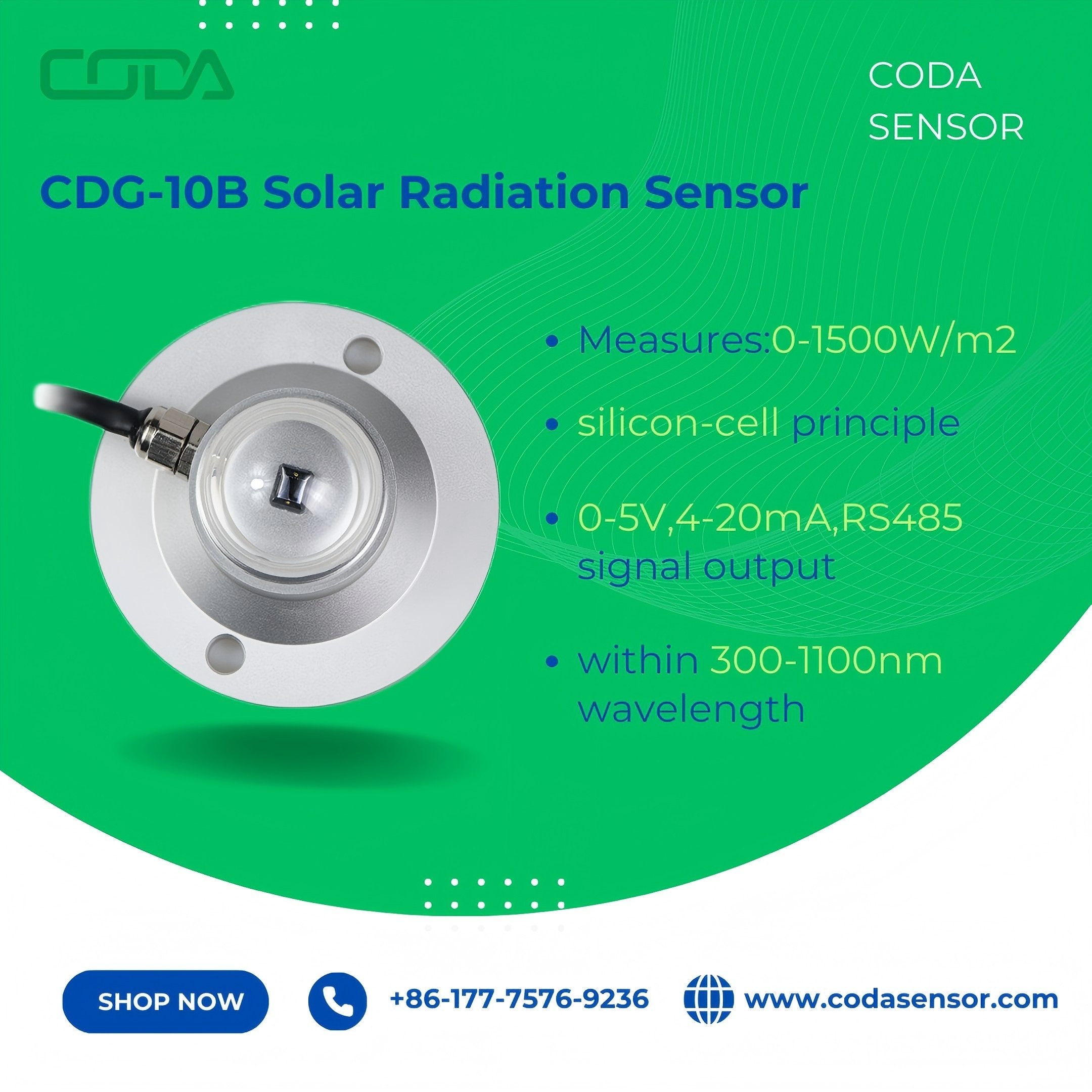
A pyranometer such as the CDG-10B measures global solar radiation, including both direct and diffuse sunlight. It uses a highly sensitive sensing element beneath a protective glass dome to detect solar energy across a wide spectral range.
Key characteristics include:
High measurement accuracy
Stable long-term performance
Fast response time
Strong environmental resistance
Compatibility with data loggers and control systems
Installed horizontally on a stable platform above crop level, the sensor continuously monitors real-time radiation intensity. The data is transmitted to the greenhouse climate monitoring system for analysis and control actions.
Modern greenhouse operations rely on centralized control platforms. A greenhouse climate monitoring system typically integrates:
Temperature sensors
Humidity sensors
CO₂ sensors
Soil moisture sensors
Solar radiation sensors
The solar radiation sensor provides a crucial input parameter for automated environmental adjustments.
When radiation levels exceed predefined thresholds, the system can:
Open roof vents
Activate circulation fans
Increase airflow
This prevents heat accumulation and stabilizes internal temperature.
Shading screens reduce excessive light intensity and prevent plant stress. By using real-time radiation data, shading can be automatically deployed only when needed, improving energy efficiency and crop protection.
Solar radiation is a key factor in evapotranspiration calculations. By combining radiation data with temperature and humidity readings, irrigation schedules can be dynamically adjusted to match plant water demand.
During low radiation periods, artificial lighting systems can be triggered to maintain consistent plant growth cycles. This is particularly important in winter production or high-latitude regions.
Stable environmental conditions lead to consistent plant development. Crops experience fewer stress events, resulting in uniform growth and higher market quality.
Optimized radiation control enhances photosynthesis efficiency, supporting stronger vegetative growth and better fruit formation.
Accurate radiation-based irrigation adjustments reduce unnecessary water use, contributing to sustainable agriculture practices.
By automating shading and ventilation only when necessary, energy consumption is minimized.
Long-term radiation data allows growers to:
Analyze seasonal trends
Compare greenhouse zones
Improve crop planning
Optimize planting schedules
Tomatoes require strong sunlight but are sensitive to overheating during flowering. Controlled radiation improves fruit set and sugar accumulation.
Crops like lettuce prefer moderate radiation levels. Excess light may trigger bolting or leaf bitterness. Radiation monitoring ensures quality preservation.
Balanced radiation enhances sweetness and color development while preventing sunburn.
Stable light intensity promotes uniform fruit size and reduces stress-related deformities.
By tailoring radiation thresholds to specific crop types, greenhouse managers can create optimal microclimates for each production zone.
Proper installation is critical for reliable data:
Mount horizontally
Avoid shading from structures
Install above crop canopy
Keep dome clean and free from dust
Routine maintenance ensures consistent accuracy and long service life.
Sustainability is a growing priority in modern agriculture. Efficient climate control reduces:
Water waste
Energy consumption
Crop loss
Chemical dependency
By integrating a greenhouse solar radiation sensor into a comprehensive monitoring system, farms can achieve both economic and environmental benefits.
Smart climate control not only increases profitability but also supports responsible resource management.
With the rise of IoT and cloud-based platforms, solar radiation data is increasingly integrated into advanced analytics systems. Future developments include:
AI-based crop growth prediction
Automated climate optimization algorithms
Remote greenhouse monitoring
Real-time mobile alerts
As greenhouses become more intelligent, solar radiation sensors will remain a core environmental parameter for precision control.
Solar radiation is one of the most influential factors in greenhouse agriculture. While essential for plant growth, it must be carefully managed to avoid overheating, water stress, and reduced crop quality.
A greenhouse solar radiation sensor, integrated into a comprehensive greenhouse climate monitoring system, provides the real-time data necessary for automated ventilation, shading, irrigation, and lighting control.
By leveraging accurate radiation monitoring, greenhouse operators can:
Improve crop stability
Increase yield and quality
Optimize resource usage
Enhance sustainability
Reduce operational risks
In modern smart agriculture, data is power — and solar radiation data is one of the most valuable inputs for greenhouse success.
What are the uses of a rain gauge? Learn how rai
Learn how PAR sensors measure PPFD, optimize gro
Learn how soil EC sensors help optimize fertiliz
Contact: Molly
Phone: +86-17775769236
Tel: 86-0731-85117089
Email: molly@codasensor.com
Add: Building S5, Aux Square, Yuelu District, Changsha City, Hunan Province, China
We chat






 English


