With the rapid adoption of smart agriculture technologies, farmers are increasingly relying on environmental monitoring systems to improve crop productivity and farm management efficiency. Modern farms and greenhouses now integrate multiple sensors to measure key environmental parameters such as temperature, humidity, soil moisture, solar radiation, rainfall, and wind conditions.
However, barometric pressure is another critical environmental factor that plays a significant role in agricultural climate analysis and weather prediction. Atmospheric pressure changes often indicate upcoming weather shifts, which can directly influence crop health, irrigation planning, and greenhouse climate stability.
By integrating reliable sensors such as the CDW-10A Wall-Mounted Barometric Pressure Sensor, agricultural monitoring systems can collect accurate atmospheric pressure data and provide valuable insights for precision farming and greenhouse management.
Barometric pressure refers to the weight of the air in the Earth's atmosphere. Variations in atmospheric pressure are closely associated with weather changes.
For example:
Falling pressure often signals incoming rain, storms, or strong winds
Rising pressure typically indicates stable and clear weather
Rapid pressure fluctuations may indicate unstable weather conditions
In agriculture, these pressure changes can significantly impact crop growth and farm operations.
Farmers who monitor atmospheric pressure alongside other weather parameters can better anticipate environmental changes and take proactive actions. This is particularly useful for agricultural weather stations, which combine pressure sensors with temperature, humidity, rainfall, and wind sensors to provide comprehensive climate data.
Such integrated monitoring helps farmers reduce weather-related risks and improve farm planning.
Greenhouses require carefully controlled environments to maintain optimal conditions for plant growth. Climate control systems in greenhouses typically monitor temperature, humidity, and carbon dioxide levels.
However, adding barometric pressure monitoring can significantly improve greenhouse climate management.
External atmospheric pressure changes can affect greenhouse ventilation, humidity levels, and airflow patterns. By monitoring pressure trends, greenhouse control systems can better anticipate outside weather changes and adjust internal climate settings accordingly.
For example, when atmospheric pressure drops, it may indicate incoming rain or increased humidity. Greenhouse systems can respond by adjusting ventilation or dehumidification to maintain stable growing conditions.
This additional environmental data helps greenhouse operators maintain a balanced microclimate, which reduces plant stress and improves crop quality.
Crop diseases often develop when environmental conditions become favorable for fungal or bacterial growth. High humidity, poor air circulation, and sudden weather changes can significantly increase disease risks.
Atmospheric pressure monitoring provides valuable clues about these environmental shifts.
A sudden drop in barometric pressure often indicates approaching rain or moisture-heavy weather conditions, which may increase humidity levels around crops. When this data is combined with humidity, temperature, and leaf wetness sensors, farmers can detect potential disease risks much earlier.
Early detection allows growers to implement preventive strategies such as:
Increasing greenhouse ventilation
Adjusting irrigation schedules
Enhancing air circulation
Applying protective crop treatments if necessary
This proactive approach reduces crop damage and improves overall farm productivity.
Precision agriculture relies on collecting accurate environmental data to support smarter farming decisions. Sensors deployed across farms and greenhouses generate continuous streams of data that help farmers understand environmental trends and crop conditions.
Barometric pressure data is an important component of this agricultural data ecosystem.
When combined with other environmental sensors, pressure data can help support applications such as:
Smart irrigation systems
Crop growth analysis
Agricultural weather forecasting
Farm climate modeling
Integrated smart farm management platforms
By analyzing long-term pressure trends alongside other weather data, farmers can gain a deeper understanding of their farm’s microclimate and improve their operational strategies.
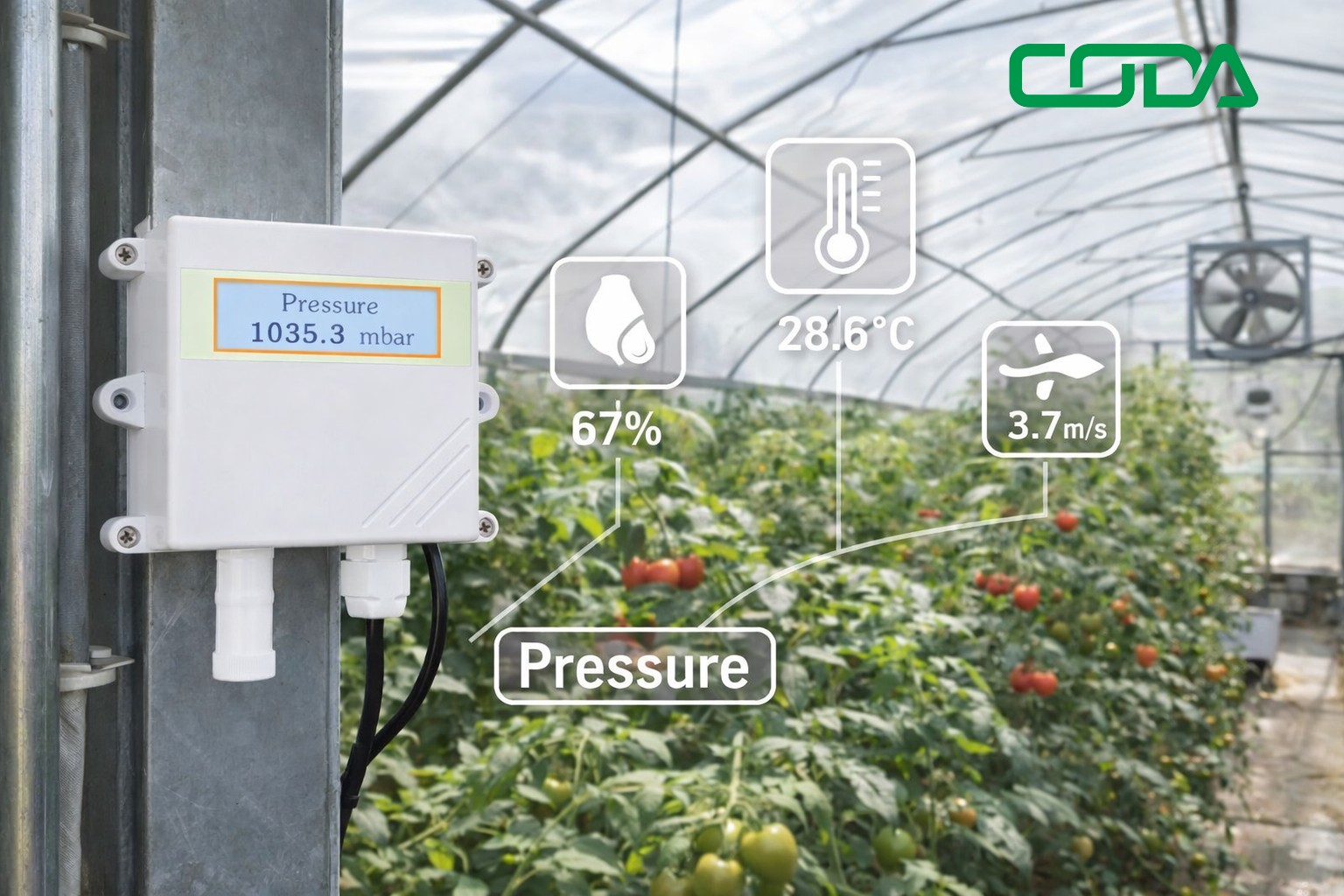
The CDW-10A Wall-Mounted Barometric Pressure Sensor is designed to provide reliable atmospheric pressure monitoring for environmental and agricultural applications.
Its stable performance and high measurement accuracy make it suitable for continuous monitoring in smart agriculture systems.
Key advantages include:
High-precision atmospheric pressure measurement
Stable long-term performance
Easy wall-mounted installation
Compact design suitable for greenhouses and monitoring stations
Compatibility with agricultural weather monitoring systems
The sensor can be easily integrated into smart agriculture monitoring networks, greenhouse climate systems, and agricultural weather stations, providing real-time atmospheric pressure data for farm management platforms.
The CDW-10A barometric pressure sensor can be widely used in various agricultural monitoring scenarios, including:
Smart greenhouse climate monitoring
Precision farming systems
Smart irrigation management platforms
Agricultural research and environmental monitoring projects
By incorporating atmospheric pressure monitoring into agricultural systems, farmers can better understand environmental trends and maintain optimal growing conditions for crops.
As agriculture becomes increasingly technology-driven, environmental monitoring systems are playing a vital role in improving farm productivity and sustainability. While temperature, humidity, and soil parameters remain essential, barometric pressure monitoring adds valuable insight into weather trends and climate stability.
By integrating reliable sensors like the CDW-10A Wall-Mounted Barometric Pressure Sensor, farmers and greenhouse operators can strengthen their environmental monitoring capabilities, anticipate weather changes, and improve crop protection strategies.
Ultimately, comprehensive environmental monitoring supports smarter agricultural decisions, healthier crops, and more efficient farm management.
What are the uses of a rain gauge? Learn how rai
Learn how PAR sensors measure PPFD, optimize gro
Learn how soil EC sensors help optimize fertiliz
Contact: Molly
Phone: +86-17775769236
Tel: 86-0731-85117089
Email: molly@codasensor.com
Add: Building S5, Aux Square, Yuelu District, Changsha City, Hunan Province, China
We chat






 English


