Precision agriculture is revolutionizing modern farming by shifting traditional practices toward data-driven decision-making. Instead of relying on experience or guesswork, farmers now use advanced technologies to monitor, analyze, and optimize every aspect of crop production.
At the heart of this transformation are agricultural sensors. These devices collect real-time data on soil, weather, and environmental conditions, enabling farmers to make smarter decisions that improve crop yield, reduce costs, and enhance sustainability.
In this article, we will explore the main types of sensors used in precision agriculture, how they work, and why they are essential for modern farming.
Soil is the foundation of agriculture, and understanding its condition is critical for crop success. Soil sensors provide detailed insights into underground conditions that directly affect plant growth.
Soil Moisture Sensors
These sensors measure the water content in soil, helping farmers determine when and how much to irrigate. Overwatering and underwatering can both harm crops, making accurate moisture monitoring essential.
Soil Temperature Sensors
Soil temperature influences seed germination and root development. Monitoring temperature helps farmers choose the right planting time.
Soil pH Sensors
Soil pH affects nutrient availability. If the pH is too high or too low, plants cannot absorb essential nutrients effectively.
Soil EC (Electrical Conductivity) Sensors
EC sensors measure the salinity and nutrient concentration in soil. This helps optimize fertilizer usage and avoid over-fertilization.
NPK Sensors
These sensors measure nitrogen (N), phosphorus (P), and potassium (K), which are critical nutrients for plant growth.
Modern devices, like integrated soil probes, can measure multiple parameters simultaneously—such as moisture, temperature, EC, pH, and nutrients. These all-in-one solutions are widely used in smart agriculture systems for real-time monitoring.
Weather plays a crucial role in agriculture. Sudden changes in temperature, humidity, or rainfall can significantly impact crop health.
Air Temperature and Humidity Sensors
These sensors help monitor microclimate conditions in fields or greenhouses.
Rain Gauges
Measure rainfall to support irrigation planning and water management.
Wind Speed and Direction Sensors
Essential for spraying operations, as wind can affect pesticide distribution.
Barometric Pressure Sensors
Used to predict weather changes and improve forecasting accuracy.
Weather sensors are often integrated into automated weather stations, providing continuous environmental data. This helps farmers:
Adjust irrigation schedules
Prevent crop diseases
Plan field activities efficiently
Light is a key factor in photosynthesis, which directly impacts crop growth and yield.
Solar Radiation Sensors (Pyranometers)
Measure total solar energy received by crops.
PAR Sensors (Photosynthetically Active Radiation)
Measure the portion of light used by plants for photosynthesis.
Illuminance Sensors
Monitor general light intensity.
By monitoring light levels, farmers can:
Optimize greenhouse lighting
Improve crop growth conditions
Maximize photosynthesis efficiency
Carbon dioxide (CO₂) is essential for photosynthesis. Monitoring CO₂ levels is especially important in controlled environments like greenhouses.
Enhances plant growth
Improves yield quality
Supports controlled environment agriculture
Maintaining optimal CO₂ levels ensures that plants can perform photosynthesis efficiently, especially in high-density farming systems.
Leaf wetness sensors detect the presence of moisture on plant surfaces.
Helps predict fungal diseases
Supports disease prevention strategies
Reduces unnecessary pesticide use
When leaves remain wet for extended periods, the risk of disease increases. Monitoring leaf wetness allows farmers to take preventive action.
Efficient water management is critical in agriculture, especially in regions with limited water resources.
Water Level Sensors
Monitor reservoirs, tanks, and irrigation systems.
Flow Sensors
Measure water usage in irrigation systems.
Optimize irrigation efficiency
Prevent water waste
Ensure consistent water supply
Precision agriculture relies heavily on accurate field mapping.
Enables precision planting
Supports automated machinery
Improves field mapping and monitoring
GPS data allows farmers to apply inputs (water, fertilizer, pesticides) precisely where needed, reducing waste and increasing efficiency.
Remote sensing technologies use drones, satellites, or cameras to monitor crops.
Multispectral Sensors
Capture data beyond visible light to assess plant health.
Thermal Sensors
Detect temperature differences in crops.
Identify crop stress early
Monitor large areas efficiently
Improve yield prediction
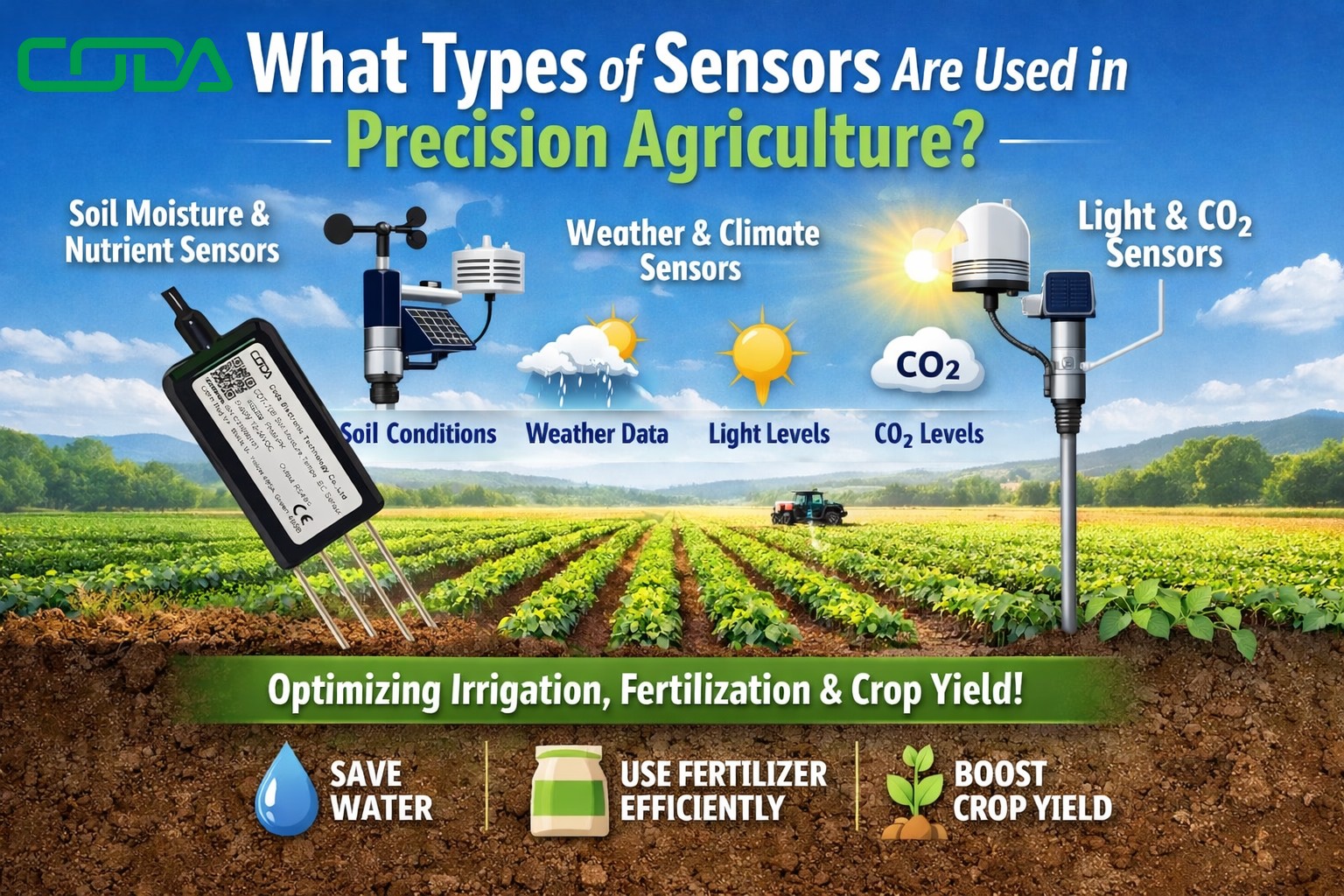
The true power of precision agriculture lies in integration. Different sensors work together to provide a complete picture of farm conditions.
For example:
Soil moisture data triggers irrigation systems
Weather data adjusts irrigation schedules
Light and CO₂ data optimize greenhouse environments
All this data is typically transmitted to cloud platforms, where it is analyzed and presented in user-friendly dashboards.
Accurate data allows farmers to optimize growing conditions, leading to higher productivity.
Sensors help reduce water, fertilizer, and pesticide usage.
Minimizing waste and improving efficiency lowers operational costs.
Precision agriculture supports environmentally friendly farming practices.
Real-time monitoring enables faster and more accurate decision-making.
The future of precision agriculture is closely tied to technological advancements:
IoT Integration
Sensors connected via wireless networks (LoRa, NB-IoT)
AI and Data Analytics
Advanced algorithms for predictive farming
Automation
Fully automated irrigation and fertilization systems
Smart Farming Platforms
Centralized dashboards for real-time monitoring and control
These innovations will continue to improve efficiency and sustainability in agriculture.
Sensors are the backbone of precision agriculture. From soil monitoring to climate analysis, these devices provide the data needed to make informed decisions and optimize farming operations.
As agriculture faces challenges such as climate change, water scarcity, and increasing food demand, the adoption of sensor technologies will become even more critical.
By leveraging advanced sensors, farmers can achieve higher yields, reduce costs, and build a more sustainable future for agriculture.
There is no single most important sensor. However, soil moisture sensors are often considered essential because irrigation management directly impacts crop growth.
Soil sensors provide real-time data on moisture, nutrients, and pH, allowing farmers to optimize irrigation and fertilization, which leads to healthier crops and higher yields.
Costs vary depending on the type and complexity. While initial investment may be high, sensors significantly reduce long-term costs through improved efficiency.
Yes, most modern agricultural sensors support IoT integration, enabling remote monitoring and control via cloud platforms.
Precision agriculture sensors are used in:
Crop farming
Greenhouses
Orchards and vineyards
Smart irrigation systems
Environmental monitoring
What are the uses of a rain gauge? Learn how rai
Learn how PAR sensors measure PPFD, optimize gro
Learn how soil EC sensors help optimize fertiliz
Contact: Molly
Phone: +86-17775769236
Tel: 86-0731-85117089
Email: molly@codasensor.com
Add: Building S5, Aux Square, Yuelu District, Changsha City, Hunan Province, China
We chat






 English


