As urban populations continue to grow, cities around the world are facing increasing pressure to improve efficiency, sustainability, and quality of life. Traffic congestion, air pollution, noise, energy consumption, and climate challenges are becoming more complex and harder to manage using traditional methods.
To address these challenges, cities are evolving into smart cities—urban environments that use digital technologies and data-driven solutions to optimize infrastructure, improve public services, and enhance environmental sustainability.
At the heart of this transformation are environmental sensors. These sensors collect real-time data on air quality, weather conditions, noise levels, water quality, and other environmental parameters. By turning physical conditions into actionable data, environmental sensors enable city managers, planners, and policymakers to make informed decisions.
Environmental monitoring is no longer optional. It is becoming a critical foundation for building smarter, safer, and more sustainable cities.
Environmental sensors are devices designed to measure physical and chemical conditions in the surrounding environment. These sensors can monitor a wide range of parameters, including:
Air quality (CO₂, NO₂, PM2.5, PM10)
Temperature and humidity
Noise levels
Wind speed and direction
Rainfall
Solar radiation
Water quality
These sensors are typically deployed across urban areas and connected through communication networks such as LoRa, NB-IoT, or 4G/5G. The collected data is transmitted to cloud platforms where it can be analyzed, visualized, and used to support decision-making.
In smart cities, environmental sensors act as the “eyes and ears” of urban systems.
Cities are complex ecosystems where environmental conditions directly impact public health, infrastructure, and economic activity. Without accurate data, it is difficult to manage these systems effectively.
Environmental sensors provide several key benefits:
Sensors provide continuous monitoring, allowing city authorities to understand what is happening in real time rather than relying on periodic reports.
With accurate data, city planners can make informed decisions about traffic management, pollution control, and urban development.
Environmental sensors can detect abnormal conditions such as high pollution levels, extreme weather, or flooding, enabling early warnings and faster response.
Smart monitoring helps optimize the use of energy, water, and infrastructure resources, reducing waste and improving efficiency.
Air pollution is one of the most serious challenges facing modern cities. Pollutants such as carbon dioxide (CO₂), nitrogen dioxide (NO₂), and particulate matter (PM2.5) can have significant health impacts.
Environmental sensors installed across urban areas can provide real-time air quality data. This information helps:
Identify pollution hotspots
Issue health warnings to citizens
Support environmental regulations
Optimize traffic flow to reduce emissions
With accurate air quality data, cities can take proactive measures to improve urban air conditions.
Weather conditions play a critical role in city operations. Environmental sensors integrated into urban weather stations monitor parameters such as temperature, humidity, rainfall, wind, and solar radiation.
This data supports:
Urban planning and infrastructure design
Flood prevention and drainage management
Heat island effect analysis
Renewable energy optimization
For example, temperature and humidity sensors help cities understand heat distribution and implement cooling strategies in densely populated areas.
Noise pollution is an often overlooked but important issue in urban environments. High noise levels can affect public health, causing stress, sleep disturbances, and reduced productivity.
Noise sensors installed in cities help monitor sound levels in real time. This enables authorities to:
Identify noise pollution sources
Enforce regulations
Improve urban planning
Enhance living conditions
Noise monitoring is becoming increasingly important as cities grow more densely populated.
Clean water is essential for public health and urban sustainability. Environmental sensors can monitor water quality in rivers, lakes, and urban water systems.
Parameters such as pH, dissolved oxygen, turbidity, and conductivity are commonly measured.
These sensors help:
Detect contamination early
Ensure safe drinking water
Monitor wastewater treatment systems
Protect aquatic ecosystems
Real-time water monitoring allows for faster response to pollution events.
Traffic congestion is a major source of urban pollution. Environmental sensors can be integrated with traffic management systems to monitor vehicle emissions and air quality.
By analyzing this data, cities can:
Optimize traffic flow
Reduce congestion
Lower emissions
Improve public transportation planning
This integration supports more efficient and environmentally friendly urban mobility.
Environmental sensors are a key component of the Internet of Things (IoT) ecosystem in smart cities. These sensors collect data and transmit it to centralized platforms where it can be processed and analyzed.
Smart city platforms enable:
Data visualization dashboards
Real-time alerts and notifications
Predictive analytics
Integration with other urban systems
For example, air quality data can be linked with traffic systems to automatically adjust traffic flow during high pollution periods.
Cloud-based platforms also allow city managers to monitor multiple locations from a single interface, improving operational efficiency.
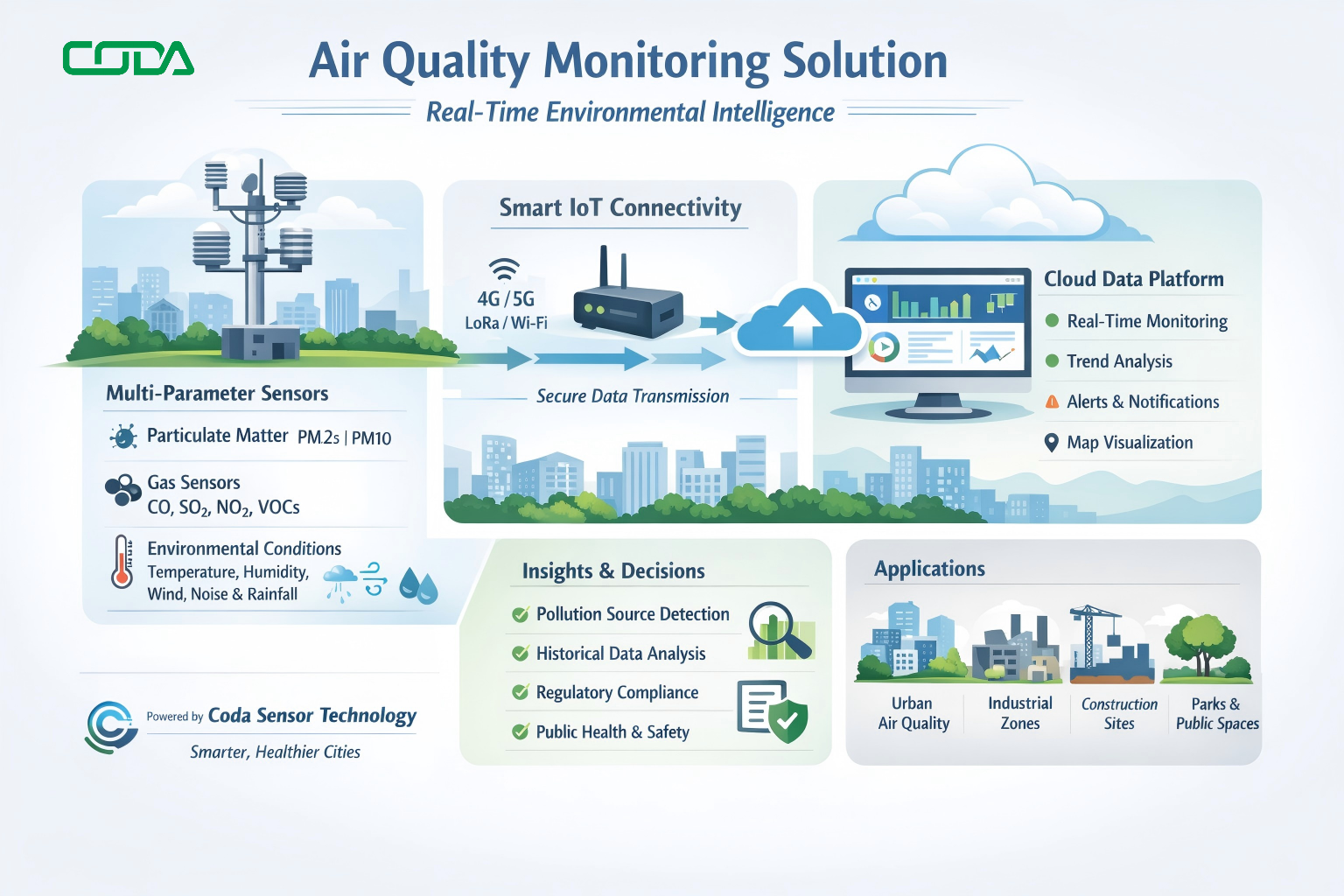
By monitoring air quality, noise, and environmental conditions, cities can reduce health risks and improve overall quality of life.
Environmental data helps cities reduce emissions, conserve resources, and promote sustainable development.
Accurate environmental data supports smarter urban design, ensuring infrastructure can handle future demands.
Public access to environmental data builds trust and encourages community participation in sustainability efforts.
While environmental sensors offer many benefits, there are also challenges:
Data accuracy and calibration
Sensor maintenance
Network connectivity
Data integration from multiple sources
To overcome these challenges, cities need reliable sensor technologies and well-designed monitoring systems.
The future of smart cities will be increasingly data-driven. Advances in sensor technology, artificial intelligence, and data analytics will enable more sophisticated environmental monitoring systems.
Emerging trends include:
AI-based predictive analytics
Digital twins of cities
Autonomous environmental monitoring systems
Integration with renewable energy systems
Environmental sensors will continue to play a central role in shaping smarter, more resilient cities.
Environmental sensors are a fundamental building block of smart cities. By providing real-time data on air quality, weather conditions, noise, and water quality, these sensors enable cities to operate more efficiently and sustainably.
As urban areas continue to grow, the importance of environmental monitoring will only increase. Cities that invest in smart sensor technologies will be better equipped to address environmental challenges, improve public health, and create a higher quality of life for their citizens.
In the era of smart cities, data is the key—and environmental sensors are the source.
What are the uses of a rain gauge? Learn how rai
Learn how PAR sensors measure PPFD, optimize gro
Learn how soil EC sensors help optimize fertiliz
Contact: Molly
Phone: +86-17775769236
Tel: 86-0731-85117089
Email: molly@codasensor.com
Add: Building S5, Aux Square, Yuelu District, Changsha City, Hunan Province, China
We chat






 English


