Agriculture has always been deeply connected to weather conditions. From ancient farming practices to modern precision agriculture, understanding weather patterns remains essential for achieving stable yields and minimizing risks. Today, as climate variability increases and farming becomes more technology-driven, weather stations have become a critical tool on farms around the world.
A weather station is more than just a device that measures temperature or rainfall. It is a comprehensive monitoring system that collects real-time environmental data such as humidity, wind speed, solar radiation, soil moisture, and atmospheric pressure. This data enables farmers to make informed decisions, improve efficiency, and reduce uncertainty.
This article explores in depth why weather stations are installed in farms, highlighting their role in improving productivity, reducing costs, managing risks, and supporting sustainable agriculture.
One of the primary reasons farmers install weather stations is to enable precision agriculture. Unlike traditional farming, which often relies on general forecasts or experience, precision agriculture uses localized data to guide every decision.
Weather conditions can vary significantly even within a small geographic area. A regional weather forecast may not accurately reflect the microclimate of a specific farm. By installing an on-site weather station, farmers gain access to highly accurate, real-time data tailored to their exact location.
With this information, farmers can:
Determine the best planting and harvesting times
Adjust irrigation schedules based on actual conditions
Apply fertilizers and pesticides more effectively
This level of precision helps maximize crop yield while minimizing waste and resource use.
Water management is one of the most critical aspects of farming. Over-irrigation wastes water and can damage crops, while under-irrigation leads to stress and reduced yields.
Weather stations play a vital role in optimizing irrigation by providing key data such as:
Rainfall levels
Temperature
Humidity
Solar radiation
Wind speed
These parameters are used to calculate evapotranspiration (ET), which indicates how much water crops are losing to the atmosphere. By understanding ET, farmers can irrigate only when necessary and in the right amount.
Benefits include:
Water conservation
Reduced energy costs
Healthier crop growth
Prevention of soil erosion and nutrient leaching
In regions facing water scarcity, this capability is especially valuable.
Weather conditions have a direct impact on crop health and the spread of diseases and pests. Many plant diseases thrive under specific combinations of temperature, humidity, and moisture.
Weather stations help farmers monitor these conditions in real time and predict potential risks. For example:
High humidity and warm temperatures may promote fungal diseases
Prolonged leaf wetness can increase infection risks
Sudden temperature drops may lead to frost damage
With early warnings, farmers can take preventive actions such as:
Applying fungicides at the optimal time
Adjusting irrigation to reduce humidity
Deploying frost protection measures
This proactive approach reduces crop losses and minimizes the need for excessive chemical use.
Fertilizers are essential for crop growth, but their effectiveness depends heavily on environmental conditions. Applying fertilizers at the wrong time can lead to nutrient loss due to runoff, leaching, or volatilization.
Weather stations provide insights that help farmers optimize fertilizer application:
Avoid applying before heavy rainfall to prevent runoff
Apply during optimal temperature conditions for absorption
Monitor soil moisture to ensure nutrients reach plant roots
By aligning fertilizer use with weather conditions, farmers can:
Increase nutrient uptake efficiency
Reduce environmental pollution
Lower input costs
Harvest timing is crucial for maintaining crop quality and maximizing market value. Weather plays a major role in determining when crops should be harvested.
For example:
Rainfall during harvest can damage crops and reduce quality
High humidity can lead to mold or spoilage
Strong winds may cause physical damage
Weather stations allow farmers to:
Monitor short-term weather trends
Plan harvest operations during optimal conditions
Reduce post-harvest losses
This is particularly important for high-value crops such as fruits, vegetables, and specialty crops.
Extreme weather events pose significant risks to agriculture. Frost, heatwaves, storms, and strong winds can cause severe damage in a short period.
Weather stations help farmers detect and respond to these threats early:
Temperature sensors can trigger frost alerts
Wind sensors can warn of approaching storms
Solar radiation data can indicate heat stress risks
With timely alerts, farmers can implement protective measures such as:
Activating frost protection systems (e.g., sprinklers or heaters)
Securing structures like greenhouses
Adjusting irrigation to cool crops during heatwaves
Early intervention can make the difference between a successful harvest and a complete loss.
Farming operations often depend on weather conditions. Activities such as spraying, planting, and harvesting must be carefully timed to ensure effectiveness.
Weather stations help farmers schedule operations more efficiently:
Avoid spraying during high winds to prevent drift
Plan fieldwork when soil conditions are suitable
Reduce downtime caused by unexpected weather changes
This leads to:
Better use of labor and machinery
Lower operational costs
Improved overall productivity
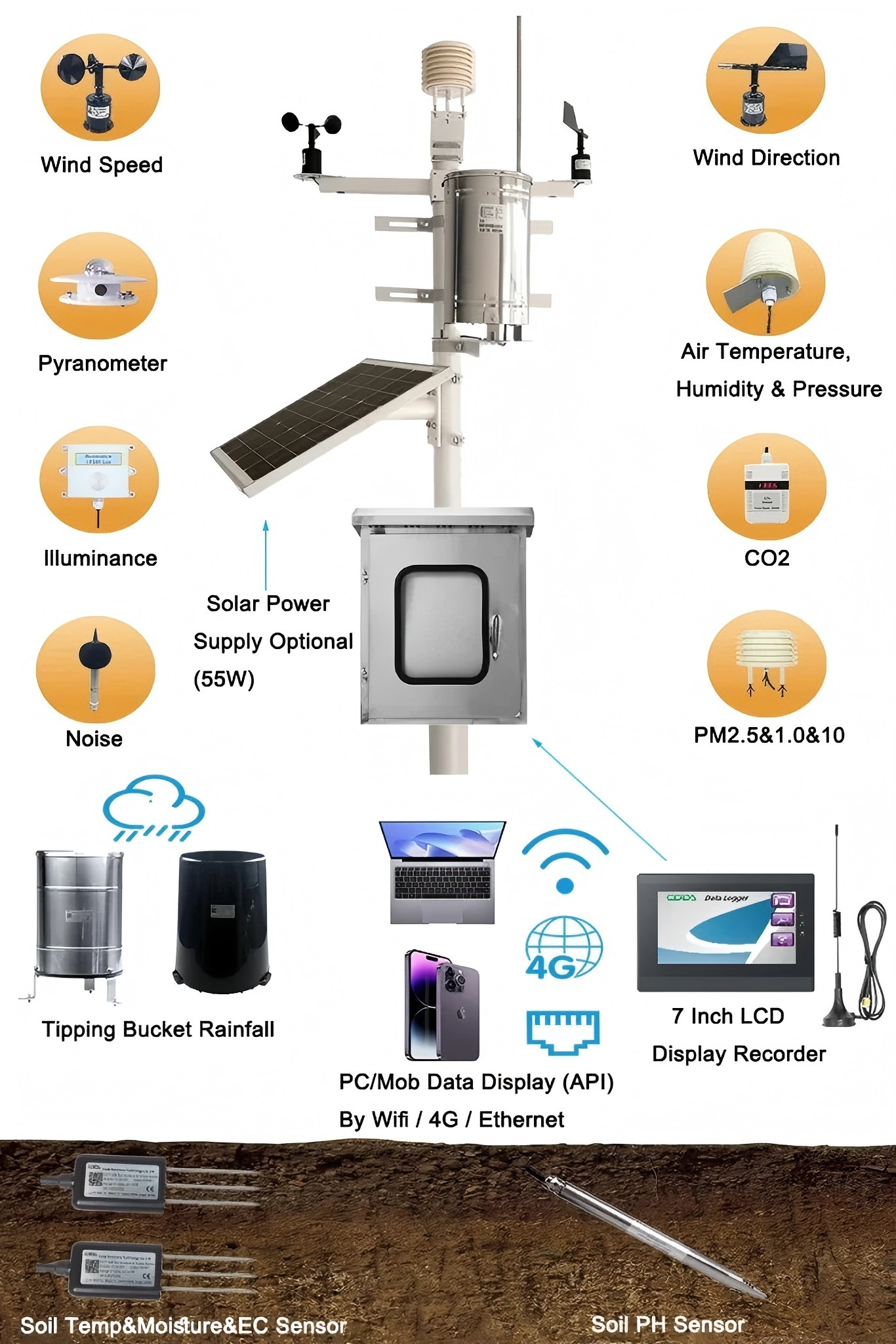
Modern farms are increasingly adopting smart agriculture technologies, including IoT (Internet of Things) systems and automated equipment. Weather stations serve as a central data source for these systems.
For example:
Irrigation systems can automatically adjust based on weather data
Greenhouses can regulate temperature and humidity in real time
Cloud platforms can provide remote monitoring and analytics
By integrating weather stations with digital platforms, farmers gain:
Real-time visibility of farm conditions
Remote control of equipment
Data-driven insights for long-term planning
This transformation is driving the future of agriculture.
Climate change is making weather patterns more unpredictable. Farmers are facing increased uncertainty due to:
Irregular rainfall
More frequent extreme weather events
Shifting growing seasons
Weather stations provide the data needed to adapt to these changes. By analyzing historical and real-time data, farmers can:
Identify trends and adjust crop selection
Modify planting schedules
Implement climate-resilient farming practices
This adaptability is essential for maintaining productivity in a changing environment.
Beyond daily operations, weather stations contribute to long-term farm management and planning. Continuous data collection allows farmers to build a detailed record of environmental conditions over time.
This data can be used to:
Analyze yield performance in relation to weather patterns
Optimize crop rotation strategies
Improve soil management practices
Support investment decisions
In addition, weather data can be valuable for:
Insurance claims
Compliance with agricultural regulations
Collaboration with research institutions
Although installing a weather station requires an initial investment, the long-term benefits often outweigh the costs.
Farmers can achieve savings through:
Reduced water usage
Lower fertilizer and pesticide consumption
Decreased crop losses
Improved operational efficiency
In many cases, the return on investment (ROI) is realized within a short period, especially for large-scale or high-value farming operations.
Sustainable agriculture is becoming increasingly important as the world faces environmental challenges. Weather stations help farmers adopt more sustainable practices by providing accurate data for resource management.
Key contributions include:
Efficient water use
Reduced chemical runoff
Lower energy consumption
Improved soil health
By minimizing environmental impact, farmers not only protect natural resources but also meet regulatory and market demands for sustainable products.
Weather stations have become an indispensable tool in modern farming. They provide precise, real-time data that empowers farmers to make informed decisions, optimize resource use, and protect their crops from risks.
From improving irrigation and crop protection to enabling smart agriculture and climate adaptation, the benefits of weather stations extend across every aspect of farm management. As agriculture continues to evolve, the role of weather monitoring will only become more critical.
For farmers seeking to increase productivity, reduce costs, and build resilience against uncertainty, installing a weather station is not just an option—it is a strategic necessity.
What are the uses of a rain gauge? Learn how rai
Learn how PAR sensors measure PPFD, optimize gro
Learn how soil EC sensors help optimize fertiliz
Contact: Molly
Phone: +86-17775769236
Tel: 86-0731-85117089
Email: molly@codasensor.com
Add: Building S5, Aux Square, Yuelu District, Changsha City, Hunan Province, China
We chat






 English


