Modern greenhouse farming has evolved far beyond traditional cultivation methods. Today, growers rely on environmental monitoring systems and intelligent automation to maximize crop yields, improve product quality, and reduce operating costs.
Among the many environmental factors that influence plant growth, carbon dioxide (CO₂) is one of the most important—but often overlooked.
While temperature, humidity, light intensity, and irrigation receive significant attention, CO₂ directly impacts photosynthesis, which is the foundation of plant growth and productivity.
This is why more commercial greenhouses are installing CO₂ sensors as part of their greenhouse monitoring systems.
In this article, we'll explore why CO₂ monitoring is essential in greenhouse cultivation, how CO₂ sensors work, their benefits, real-world applications, and how they help growers improve crop performance.
Carbon dioxide is a naturally occurring gas in the atmosphere and one of the key ingredients required for photosynthesis.
Plants use:
Sunlight
Water
Carbon dioxide
to produce energy and grow.
During photosynthesis, plants absorb CO₂ through their leaves and convert it into sugars that support:
Stem development
Leaf growth
Flower production
Fruit formation
Without adequate CO₂ levels, plant growth slows down regardless of how much water, fertilizer, or sunlight is available.
In outdoor environments, atmospheric CO₂ is constantly replenished through natural air circulation.
Inside a greenhouse, conditions are different.
As crops grow and photosynthesize throughout the day, they consume CO₂ rapidly.
When ventilation is limited or the greenhouse is tightly sealed, CO₂ concentrations can fall below optimal levels.
This can result in:
Reduced photosynthesis
Slower growth rates
Lower yields
Reduced crop quality
Without monitoring, growers may not realize that CO₂ deficiency is limiting production.
A CO₂ sensor is a device that continuously measures carbon dioxide concentration in the air.
Most greenhouse CO₂ sensors use NDIR (Non-Dispersive Infrared) technology, which provides:
High accuracy
Long-term stability
Fast response times
Low maintenance requirements
CO₂ concentration is typically measured in:
ppm (parts per million)
The sensor sends real-time data to a greenhouse monitoring system, allowing growers to monitor and control environmental conditions effectively.
Photosynthesis is directly influenced by CO₂ availability.
When CO₂ levels are optimized:
✅ Plants absorb more carbon
✅ Growth rates increase
✅ Biomass production improves
✅ Crop development accelerates
This leads to healthier plants and higher productivity.
Numerous greenhouse operations have reported significant yield improvements after implementing controlled CO₂ enrichment.
Proper CO₂ management can help:
Increase fruit production
Improve vegetable yields
Enhance flowering performance
Promote uniform crop growth
For commercial growers, even small yield improvements can create substantial financial benefits.
In addition to increasing yield, optimized CO₂ levels often improve crop quality.
Benefits may include:
Larger fruits
Better coloration
Improved plant vigor
Stronger root development
Higher-quality produce can command better market prices.
Without monitoring, growers may inject excessive amounts of CO₂ into the greenhouse.
This results in:
Higher operating costs
Increased energy consumption
Unnecessary gas usage
A CO₂ sensor ensures enrichment systems operate only when necessary, improving efficiency and reducing waste.
Modern greenhouse systems often integrate CO₂ sensors with:
Ventilation systems
CO₂ generators
Irrigation systems
Temperature sensors
Humidity sensors
Automation allows growers to maintain ideal growing conditions with minimal manual intervention.
A typical greenhouse monitoring system combines several environmental sensors, including:
CO₂ sensors
Temperature sensors
Humidity sensors
Light sensors
Data is transmitted through:
RS485 Modbus RTU
WiFi
4G communication
Cloud platforms
Farm managers can access real-time environmental data from smartphones, tablets, or computers.
Alarm notifications can be triggered when CO₂ levels exceed or fall below predefined thresholds.
CO₂ monitoring is widely used in:
For crops such as:
Tomatoes
Cucumbers
Peppers
Lettuce
Including:
Roses
Orchids
Chrysanthemums
Where precise environmental control is essential.
Indoor farms often rely heavily on CO₂ enrichment to maximize productivity.
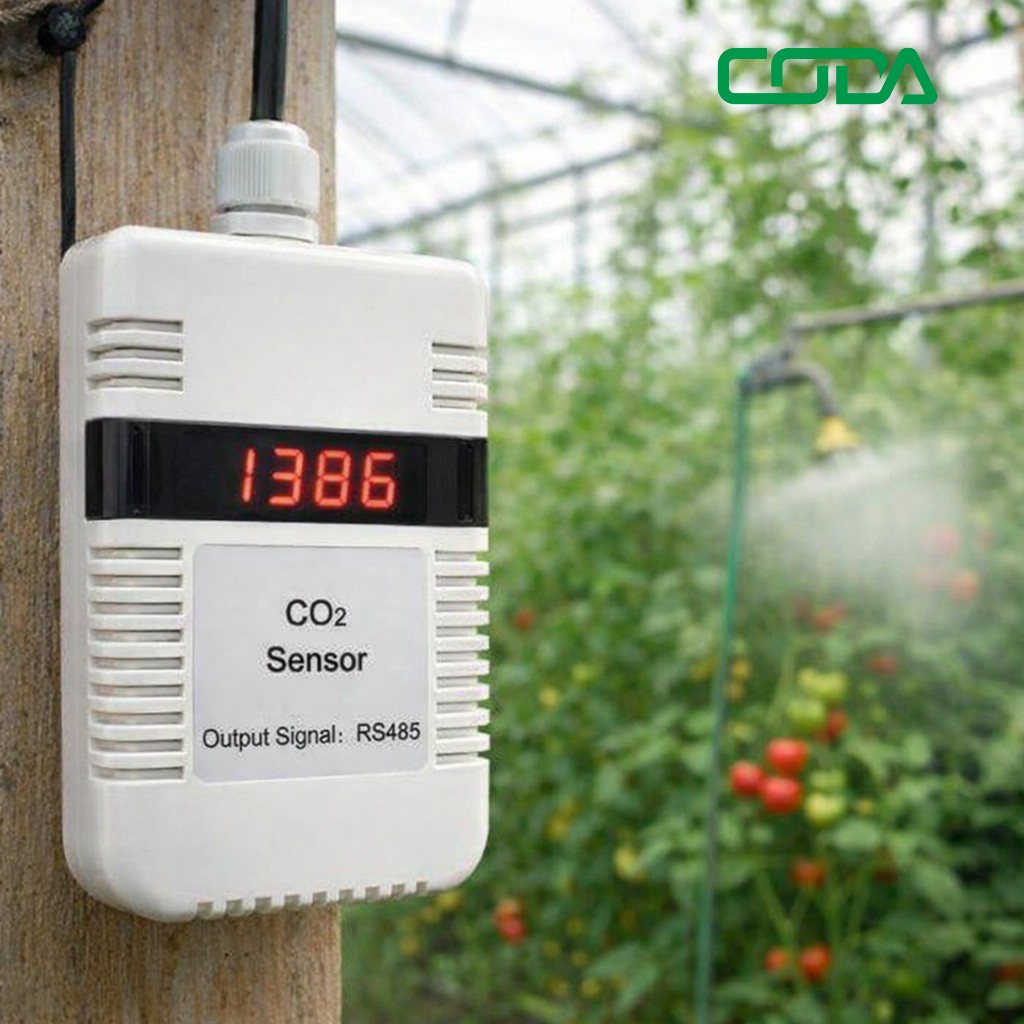
A commercial tomato producer sought to improve crop productivity and environmental control within a large greenhouse facility.
The farm experienced:
Uneven plant growth
Inconsistent yields
Rising production costs
Environmental analysis revealed frequent CO₂ deficiencies during daylight hours.
The greenhouse installed:
CO₂ sensors
Automated CO₂ enrichment equipment
The monitoring system continuously tracked environmental conditions and adjusted CO₂ injection automatically.
The farm achieved:
✅ Faster plant growth
✅ Improved fruit consistency
✅ Higher tomato yields
✅ Reduced CO₂ waste
✅ Better environmental management
The investment paid for itself through increased production efficiency.
A hydroponic farm implemented a greenhouse monitoring system to optimize crop production throughout the year.
The operation faced:
Variable growth rates
Environmental inconsistencies
High labor requirements for manual monitoring
The facility deployed:
CO₂ sensors
Temperature sensors
Humidity sensors
Cloud-based monitoring platform
The system provided real-time environmental visibility and automated control recommendations.
The farm achieved:
✅ More consistent crop growth
✅ Improved lettuce quality
✅ Reduced labor requirements
✅ Better environmental stability
✅ Increased overall productivity
The farm also gained valuable historical data for future optimization.
Greenhouse technology continues to evolve rapidly.
Future developments include:
AI-powered climate management
Automated CO₂ optimization
IoT greenhouse platforms
Wireless environmental sensors
Predictive crop analytics
Cloud-based greenhouse management systems
CO₂ monitoring will remain a critical component of precision agriculture and smart greenhouse operations.
Plants use CO₂ during photosynthesis to produce the energy required for growth and development.
Low CO₂ concentrations can reduce photosynthesis, slow growth, decrease yields, and lower crop quality.
The optimal concentration varies by crop type, but greenhouse operators commonly maintain elevated CO₂ levels to maximize photosynthesis and productivity.
Yes. Most industrial CO₂ sensors support integration with greenhouse control systems, PLCs, cloud platforms, and environmental monitoring networks.
Absolutely. CO₂ monitoring is widely used in hydroponics, indoor farming, and vertical agriculture where environmental control is critical.
CO₂ is one of the most important factors influencing greenhouse productivity. By continuously monitoring carbon dioxide levels, growers can optimize photosynthesis, improve crop quality, increase yields, and reduce operational costs.
As smart agriculture continues to advance, CO₂ sensors are becoming a standard component of modern greenhouse monitoring systems, helping growers achieve more sustainable and profitable production.
What are the uses of a rain gauge? Learn how rai
Learn how PAR sensors measure PPFD, optimize gro
Learn how soil EC sensors help optimize fertiliz
Contact: Molly
Phone: +86-17775769236
Tel: 86-0731-85117089
Email: molly@codasensor.com
Add: Building S5, Aux Square, Yuelu District, Changsha City, Hunan Province, China
We chat






 English


