In the era of data-driven agriculture and environmental stewardship, "intuition" is being replaced by "instrumentation." Among the most critical tools in this transition is the soil EC sensor. While moisture sensors tell us how much water is in the ground, the Electrical Conductivity (EC) sensor tells us what is in that water.
This 2,000-word deep dive explores the sophisticated soil EC sensor working principle, the physics of EC measurement technology, and the strategic applications that make this device the cornerstone of modern weather station data acquisition and automatic weather monitoring systems.
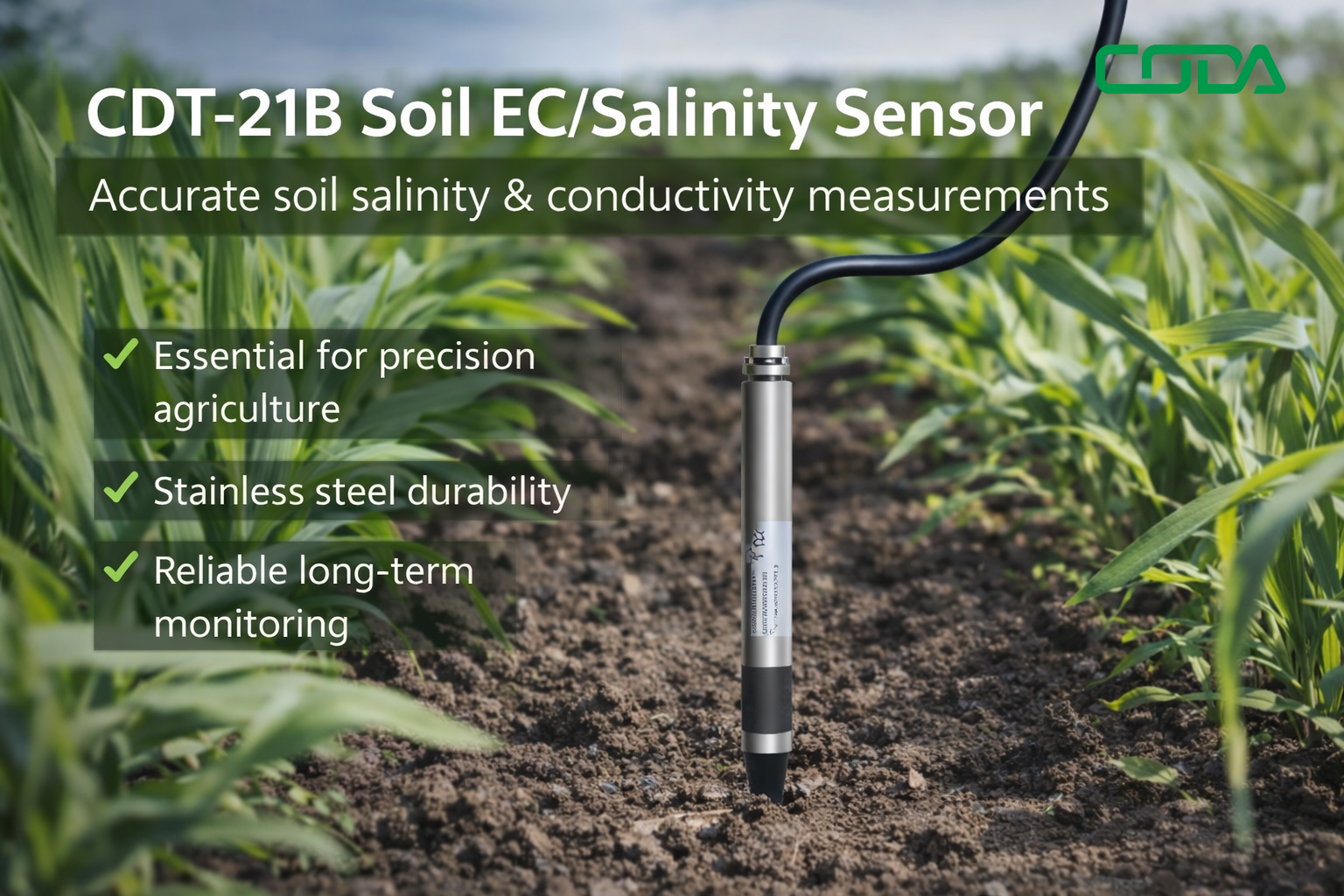
To understand the sensor, we must first understand the medium. Soil is a complex matrix of solid particles (minerals and organic matter), air, and water.
Electrical Conductivity is the measure of a material's ability to allow the transport of an electric charge. In soil, the solid particles and air are non-conductive. The electrical current travels almost exclusively through the "soil solution"—the thin film of water surrounding soil particles.
Pure water is a poor conductor. However, soil water is never pure; it contains dissolved mineral salts known as electrolytes (calcium, magnesium, potassium, sodium, nitrates, and sulfates). These salts dissociate into positively charged ions (cations) and negatively charged ions (anions). When an electrical field is applied, these ions migrate, carrying the charge.
Therefore, a soil conductivity sensor is essentially a "salt counter." The higher the concentration of dissolved nutrients or salts, the higher the EC reading.
Modern industrial sensors have moved away from simple DC resistance measurements, which were prone to errors. Today’s professional sensors utilize high-frequency electrical fields and advanced digital processing.
Most high-end environmental data loggers utilize FDR technology. The sensor generates an electromagnetic signal at a specific frequency (usually around 100 MHz). This signal is sent through the stainless steel probes into the soil.
The Dielectric Constant: The sensor measures the soil's dielectric permittivity. Because the dielectric constant of water (~80) is much higher than that of soil (3–5) or air (1), the sensor can accurately determine the moisture content and conductivity simultaneously.
Oscillation Stability: By measuring the frequency shift or the "standing wave" pattern, the sensor can isolate the electrical conductivity of the liquid phase from the physical density of the soil.
Bipolar (2-Probe): Uses two electrodes to both apply the current and measure the voltage. These are cost-effective but can suffer from "polarization" at the electrode surface, where ions crowd around the probes and create a false resistance layer.
Quadripolar (4-Probe): A more advanced EC measurement technology. Two outer electrodes apply the current, while two inner electrodes measure the voltage drop. This eliminates the "contact resistance" error, providing superior accuracy in high-salinity environments.
Physics dictates that as temperature increases, the viscosity of water decreases, allowing ions to move more freely. For every 1°C increase in temperature, the EC of soil water typically increases by about 2%.
Without compensation, a sensor would show a higher EC in the afternoon than in the morning, even if no salt levels changed. Professional sensors include an internal NTC thermistor to normalize all readings to a standard 25°C (77°F). This is known as Non-Linear Temperature Compensation.
The application of a soil conductivity sensor stretches far beyond a simple farm field. It is a critical component in any automatic weather monitoring system that seeks to understand the "Water-Soil-Atmosphere" nexus.
The most common application is "Spoon-Feeding" crops. In high-value greenhouse crops (like berries or medical cannabis), growers use EC sensors to monitor the "leachate" or the "drain-to-waste" water.
The Benefit: If the EC of the water coming out of the pot is significantly higher than the water going in, it indicates a "salt buildup," signaling the grower to flush the plants with pure water.
In Smart Cities, EC sensors are embedded in "living walls" and urban bioswales.
The Application: These sensors detect when road salts (used for de-icing) have contaminated the urban soil, allowing city managers to replace soil before the street trees die.
Mining operations and chemical plants use EC sensors as a low-cost, high-reliability leak detection system.
The Application: Around tailing ponds, a baseline EC is established. If a liner leaks, the chemical-rich wastewater enters the surrounding soil, causing an immediate and massive spike in EC, which triggers an automated alarm via an environmental data logger.
Integrating a sensor into a weather station data acquisition system requires understanding the digital handshake between the sensor and the logger.
For professional applications, the RS485 Modbus RTU protocol is the gold standard.
Long Distance: RS485 can run up to 1,200 meters (4,000 feet) without a repeater.
Multi-Drop: You can connect up to 32 (or more with repeaters) sensors on a single pair of wires.
Noise Immunity: The differential signaling ignores the electrical noise generated by heavy machinery or irrigation pumps.
To ensure the longevity of your automatic weather monitoring system, follow these wiring rules:
Termination Resistors: On long cable runs, place a 120-ohm resistor at the end of the line to prevent signal "reflection."
Grounding: Only ground the shield of your cable at one end (the logger end) to prevent "ground loops" which can fry your sensor's delicate electronics.
The most frequent cause of "sensor failure" isn't the electronics—it's the installation.
Dig a trench to the required depth (e.g., 1 meter).
Insert sensors horizontally into the undisturbed "side wall" of the trench at various depths (20cm, 40cm, 60cm).
Critical Step: Backfill the trench and compact the soil in the same order it was removed. If you put topsoil at the bottom, your EC data will be meaningless.
Some users try to "test" sensors in a bucket of water or a mud slurry. Do not do this. Professional soil EC sensors are calibrated for the Bulk EC of a soil matrix. Testing in pure water will often result in readings that appear "off" because the air-water-soil ratio is missing.
One of the most complex topics for researchers is the difference between these two values.
Bulk EC : What the sensor measures directly (the total conductivity of soil + air + water).
Pore Water EC : The conductivity of the water alone.
The Hilhorst Model: Advanced EC measurement technology often uses mathematical models (like the Hilhorst or Malicki models) to estimate Pore Water EC from Bulk EC and Moisture data. This is crucial because EC is what the plant's roots actually "feel."
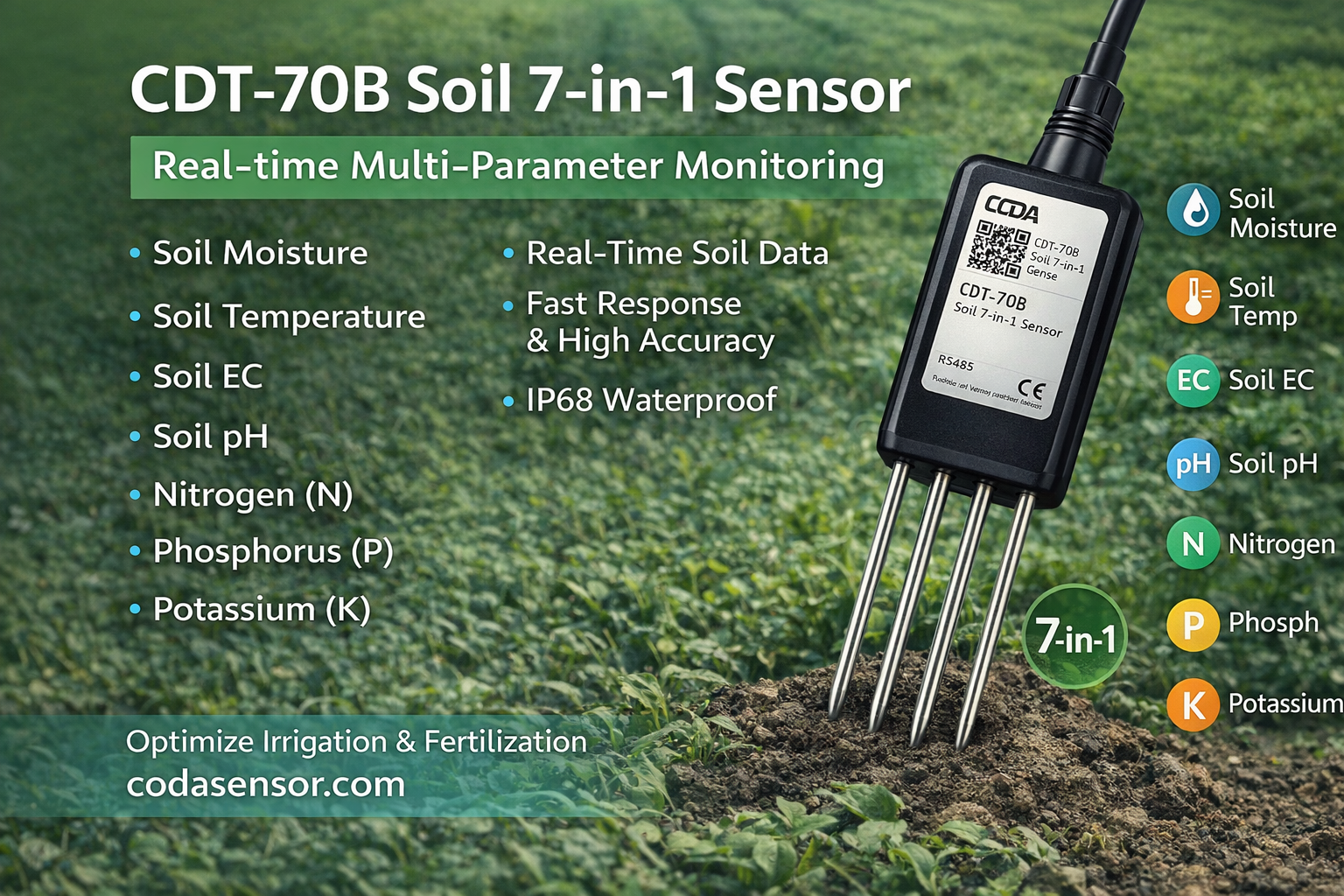
The soil EC sensor has evolved from a niche laboratory instrument into a rugged, digital workhorse. By combining the soil EC sensor working principle with robust RS485 Modbus connectivity, industries can now monitor the hidden chemistry of our planet in real-time.
As we move toward 2030, the integration of AI will allow these sensors to not just report data, but to predict it. Imagine a system that sees a rise in solar radiation, predicts the transpiration rate, and pre-emptively adjusts the EC of the irrigation water to prevent salt stress before it ever happens. This is the future of the automatic weather monitoring system.
Q: Can I use a soil EC sensor in hydroponics?
A: While they function similarly, it is better to use a dedicated "Liquid EC" sensor for open water. Soil sensors are calibrated for the dielectric properties of a soil matrix.
Q: How often should I calibrate my sensor?
A: For industrial use, we recommend a "check" every 6 months. High-quality stainless steel probes rarely drift, but mineral buildup (calcification) can occur in hard water areas.
Q: Is "Conductivity" the same as "Salinity"?
A: Not exactly. Conductivity is the measurement; Salinity is the interpretation. You can convert EC to TDS (Total Dissolved Solids) or Salinity using standard conversion factors (usually 0.5 to 0.7 depending on the salt type).
Final Call to Action:
For an environmental engineer or a precision farmer, the question isn't whether you need an EC sensor, but how you will integrate the data. In your current operation, do you prioritize measuring the Bulk EC of the soil, or are you specifically looking for the Pore Water EC to manage nutrient uptake? Join the conversation in the comments below.
What are the uses of a rain gauge? Learn how rai
Learn how PAR sensors measure PPFD, optimize gro
Learn how soil EC sensors help optimize fertiliz
Contact: Molly
Phone: +86-17775769236
Tel: 86-0731-85117089
Email: molly@codasensor.com
Add: Building S5, Aux Square, Yuelu District, Changsha City, Hunan Province, China
We chat






 English


