THE ESSENTIAL DUO: WHY INTEGRATING NOISE AND WEATHER SENSORS IS CRITICAL FOR ACCURATE OUTDOOR ENVIRONMENTAL MONITORING
Environmental engineers, project managers, and regulators often face a puzzling issue: noise measurements taken at the same location can vary significantly at different times, even when the sound source appears unchanged. This inconsistency frequently leads to questions about data reliability, compliance validity, and public trust.
The root cause is often overlooked—meteorological conditions.
In outdoor environments, sound does not travel in isolation. Wind, temperature gradients, and atmospheric humidity continuously influence how sound propagates from its source to the monitoring point. When these factors are ignored, noise data becomes difficult to compare, hard to trace, and vulnerable to regulatory challenges.
This is why professional environmental monitoring increasingly treats noise and meteorological sensors as a single, integrated system rather than independent instruments.
To understand the necessity of integration, it is important to examine how weather parameters influence sound propagation.
Wind Speed and Wind Direction
Wind alters the effective speed and direction of sound waves. When sound travels downwind, it bends toward the ground, increasing measured noise levels. Upwind propagation causes sound to refract upward, reducing received levels. Even moderate wind speeds can introduce deviations of more than 5 dB, which is critical in compliance-driven applications.
Temperature Gradients
Sound travels faster in warmer air. During temperature inversion conditions—commonly occurring at night—sound waves are refracted downward, significantly extending the noise impact area. This effect is especially relevant in airport noise monitoring, wind turbine assessments, and nighttime environmental compliance.
Humidity and Atmospheric Absorption
Humidity affects how sound energy is absorbed by the air, particularly at higher frequencies. Dry air increases attenuation, while humid conditions allow sound to travel farther with less loss. Without humidity data, long-range noise prediction models can be significantly inaccurate.
In short, noise data without meteorological context represents raw data, not environmental truth.
International standards such as ISO 1996 (Environmental Noise Measurement) clearly recognize the influence of meteorological conditions on noise results. The standard requires that measurements be excluded or corrected under unfavorable wind conditions and emphasizes the importance of recording wind speed and wind direction alongside noise data.
By integrating meteorological sensors with noise monitoring systems, engineers can automatically filter invalid data, apply correction logic, and ensure comparability across different locations, seasons, and time periods. This transformation from raw measurements to corrected data ensures that results are defensible, auditable, and suitable for regulatory review.
Noise monitoring is not only about measuring sound levels; it is about understanding where the noise comes from and how it behaves.
Source Traceability
When noise level data is combined with wind direction information, engineers can analyze correlations using wind rose diagrams to identify dominant noise sources. This approach helps distinguish between traffic, industrial, construction, or aviation noise and provides objective evidence for dispute resolution and complaint handling.
Predictive Modeling
The ISO 9613-2 standard defines internationally accepted methods for calculating outdoor sound propagation. These models require meteorological inputs such as wind conditions, temperature, and humidity. Integrated monitoring systems allow real, site-specific weather data to feed directly into propagation models, enabling accurate noise impact predictions and scenario simulations for environmental impact assessments and planning decisions.
Integrated noise and meteorological monitoring systems extend far beyond basic compliance.
In airport environments, they support flight path analysis, nighttime noise contour mapping, and community exposure studies. In wind and renewable energy projects, they enable correlation between wind resources and noise emissions, supporting both environmental assessment and stakeholder communication. In smart cities, integrated data powers dynamic noise maps, urban planning strategies, and data-driven mitigation policies.
Integration enables monitoring systems to evolve from compliance tools into strategic decision-support platforms.
CODA Sensor provides a fully integrated, field-proven solution for professional outdoor environmental monitoring.
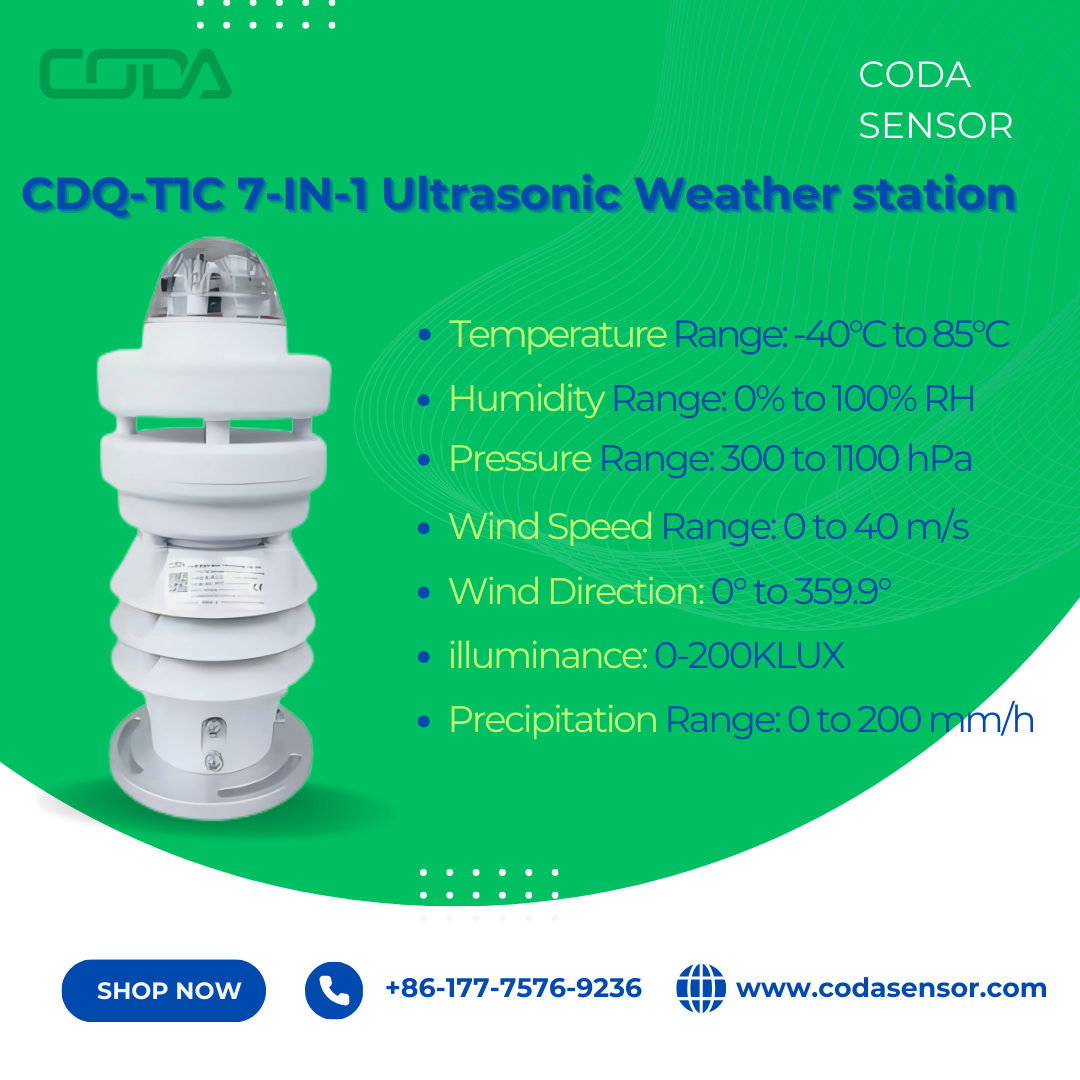
On the hardware side, CODA offers environmental noise sensors such as the CDW-13B, designed for long-term outdoor deployment with high measurement stability. These can be combined with CODA’s wind speed and wind direction sensors from the CDF series, as well as multi-parameter integrated weather stations such as the CDQ-T1C series.
All devices support standard industrial communication protocols including Modbus and RS485, enabling seamless integration into SCADA systems, third-party platforms, and government monitoring networks.
Unified Data Platform Advantage
Beyond hardware, CODA’s integrated architecture ensures synchronized timestamps, consistent calibration standards, and centralized data management. Unlike systems assembled from unrelated devices, CODA’s approach eliminates data misalignment, calibration inconsistencies, and platform fragmentation. The result is higher data integrity, lower lifecycle cost, and faster project deployment.
Airport Noise Management and Flight Optimization
Integrated wind and noise data enables accurate noise contour analysis, nighttime impact assessment, and transparent community communication.
Wind and Solar Power Environmental Impact Assessment
By correlating wind resources with noise emissions, operators gain reliable data for compliance reporting and long-term environmental evaluation.
Smart City Noise Mapping
Weather-corrected noise data supports real-time noise maps, policy-driven planning, and adaptive mitigation strategies.
Construction Site Compliance Monitoring
Integrated systems enable automated threshold alerts, meteorologically validated records, and rapid response to public complaints.
In outdoor environmental monitoring, noise data without meteorological context is incomplete. Accurate monitoring requires data correction, reliable source traceability, and predictive capability. Integrating noise and weather sensors is no longer optional—it is essential for scientific accuracy, regulatory confidence, and informed decision-making.
Contact CODA Sensor’s technical team for a free site assessment simulation, detailed technical documentation, or application-specific case studies.
This article is provided by the CODA Sensor Solutions Team, delivering professional environmental monitoring solutions worldwide.
What are the uses of a rain gauge? Learn how rai
Learn how PAR sensors measure PPFD, optimize gro
Learn how soil EC sensors help optimize fertiliz
Contact: Molly
Phone: +86-17775769236
Tel: 86-0731-85117089
Email: molly@codasensor.com
Add: Building S5, Aux Square, Yuelu District, Changsha City, Hunan Province, China
We chat






 English


