In today’s data-driven world, weather monitoring has evolved far beyond simple temperature readings. From smart agriculture and renewable energy to urban planning and environmental protection, accurate and real-time atmospheric data has become a critical foundation for decision-making. At the center of this transformation lies a powerful innovation: the 3-in-1 atmospheric sensor, capable of measuring temperature, humidity, and barometric pressure in a single compact device.
Modern weather stations are no longer just about collecting data—they are about delivering precise, reliable, and actionable insights. This is exactly where integrated sensors like the CDW-33A play a vital role. By combining multiple environmental parameters into one unit, these sensors are redefining how weather stations are designed, deployed, and operated.
Traditional weather monitoring systems relied on separate instruments for each parameter. A typical setup included individual sensors for temperature, humidity, and pressure, each requiring its own installation, calibration, wiring, and maintenance. While effective, this approach introduced several challenges:
Increased installation complexity
Higher equipment and maintenance costs
Greater risk of data inconsistency
Larger physical footprint
As industries demanded more efficient and scalable solutions, the need for integrated sensing technology became clear. This led to the development of multi-parameter sensors—devices that can measure several environmental variables simultaneously without compromising accuracy.
A 3-in-1 atmospheric sensor is a compact device designed to measure three key environmental parameters:
Temperature – Indicates the thermal condition of the environment
Humidity – Reflects the amount of moisture in the air
Barometric Pressure – Measures atmospheric pressure, essential for weather forecasting
These three parameters are deeply interconnected. Together, they provide a comprehensive understanding of atmospheric conditions, enabling more accurate predictions and smarter decision-making.
When multiple parameters are measured within the same device, they are captured under identical environmental conditions and at the same time. This eliminates discrepancies that can occur when using separate sensors placed at slightly different locations.
For example, even small spatial differences can lead to variations in humidity or temperature readings. A 3-in-1 sensor ensures synchronized data collection, resulting in more reliable datasets for analysis.
One of the biggest advantages of integrated sensors is ease of installation. Instead of mounting and wiring three separate devices, users only need to install a single unit.
This offers several benefits:
Reduced installation time
Lower labor costs
Fewer wiring and connection points
Cleaner and more compact system design
For large-scale deployments—such as smart cities or agricultural monitoring networks—this simplicity becomes a major advantage.
Using a single multi-parameter sensor is generally more cost-effective than purchasing and maintaining multiple individual sensors.
Cost savings come from:
Lower initial equipment investment
Reduced installation expenses
Decreased maintenance and calibration efforts
Lower power consumption
Over time, these savings can be substantial, especially for projects involving dozens or hundreds of monitoring points.
Fewer components mean fewer potential points of failure. Integrated sensors reduce the complexity of the system, which directly improves overall reliability.
Additionally, modern 3-in-1 sensors are often designed with:
Industrial-grade enclosures
Waterproof and dustproof protection
Strong resistance to environmental interference
This makes them ideal for harsh outdoor environments, including deserts, coastal areas, and high-altitude locations.
In many applications, space is limited. Whether it’s a compact weather station, a solar monitoring system, or a mobile environmental unit, minimizing equipment size is crucial.
A 3-in-1 sensor significantly reduces the physical footprint of the monitoring system, making it easier to integrate into:
Pole-mounted weather stations
Vehicle-mounted systems
IoT devices
Remote monitoring stations
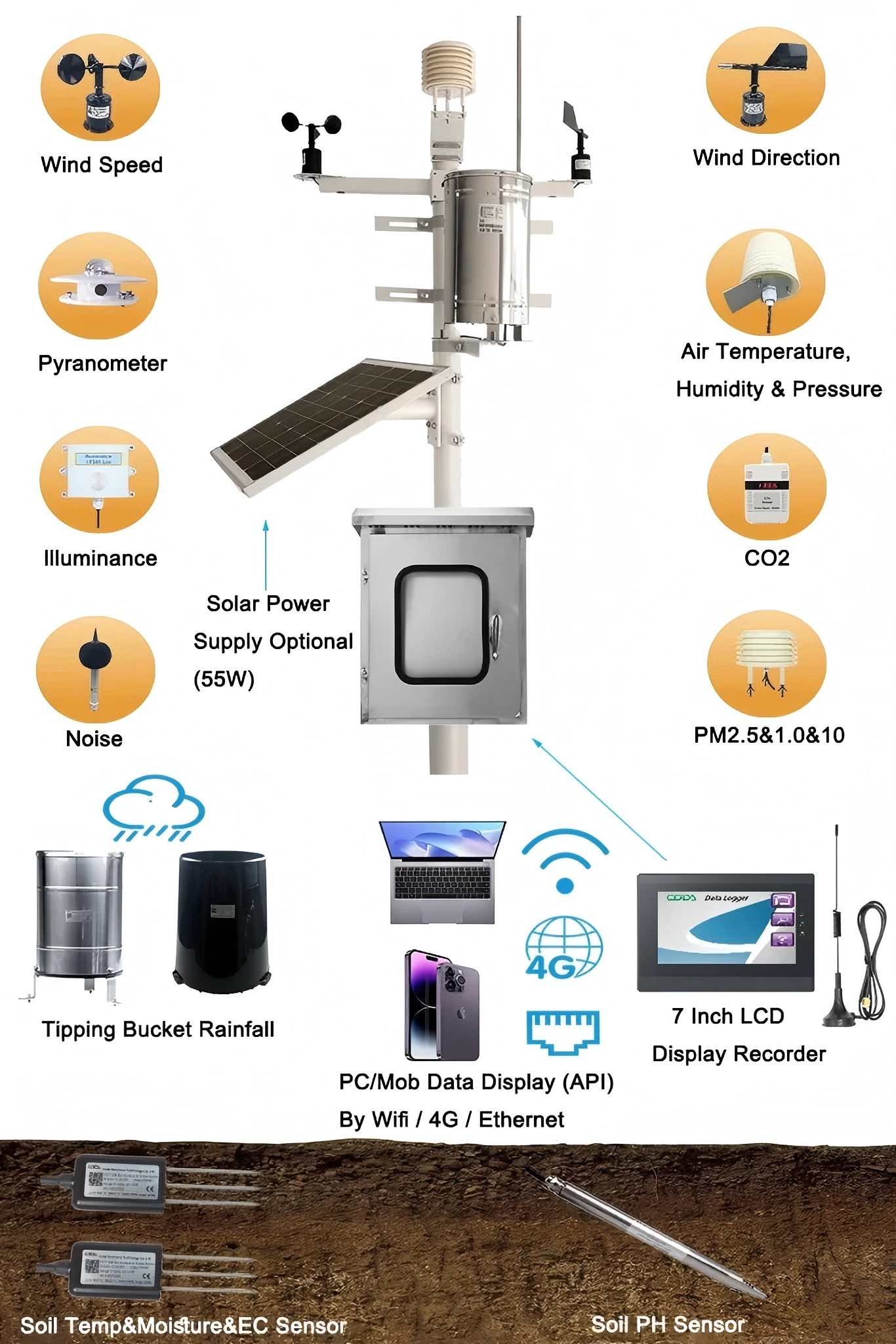
Farmers rely heavily on environmental data to optimize irrigation, fertilization, and crop protection. Temperature, humidity, and pressure all influence plant growth and disease development.
With a 3-in-1 sensor, farmers can:
Monitor microclimates in real time
Improve irrigation efficiency
Reduce crop losses
Increase yield and quality
In solar power plants, environmental conditions directly affect energy generation efficiency. Temperature impacts panel performance, while pressure and humidity influence atmospheric clarity and heat transfer.
Integrated sensors help operators:
Optimize panel performance
Predict energy output
Improve system maintenance planning
Cities are becoming smarter, and environmental monitoring is a key component of urban infrastructure. Accurate atmospheric data supports:
Air quality management
Traffic and pollution control
Disaster prevention and response
Urban climate analysis
3-in-1 sensors provide a scalable solution for deploying dense monitoring networks across urban environments.
Industries such as manufacturing, mining, and logistics require stable environmental conditions for safety and efficiency.
Applications include:
Warehouse climate control
Equipment protection
Hazard detection
Environmental compliance monitoring
Accurate weather prediction depends on high-quality data. By providing synchronized measurements of key atmospheric parameters, 3-in-1 sensors enhance:
Forecast accuracy
Climate modeling
Research data integrity
Modern 3-in-1 sensors often feature digital communication protocols such as RS485 with Modbus. This brings several advantages:
Long-distance data transmission
Strong resistance to electrical interference
Easy integration with data loggers and cloud platforms
Real-time monitoring and remote access
This makes them highly compatible with IoT systems and automated monitoring networks.
The rise of the Internet of Things (IoT) has transformed how environmental data is collected and used. Weather stations are no longer isolated systems—they are part of interconnected networks that provide continuous, real-time insights.
3-in-1 sensors are perfectly suited for IoT applications because they:
Reduce device count
Simplify network architecture
Lower power consumption
Enable scalable deployments
This is especially important for remote or off-grid installations powered by solar energy.
To maximize performance and lifespan, consider the following:
Install sensors in well-ventilated areas, away from direct heat sources
Use radiation shields to minimize solar interference
Ensure proper calibration and periodic maintenance
Protect connections from moisture and corrosion
Integrate with reliable data logging and cloud systems
As environmental challenges grow and industries demand more precise data, weather stations will continue to evolve. The future lies in:
Higher integration
Greater accuracy
Real-time connectivity
AI-driven data analysis
3-in-1 atmospheric sensors represent a key step in this evolution, offering a balance of performance, efficiency, and scalability.
The shift toward integrated sensing technology is not just a trend—it is a necessity for modern environmental monitoring. 3-in-1 atmospheric sensors provide a smarter, more efficient way to collect critical data, enabling better decisions across agriculture, energy, urban development, and beyond.
By combining temperature, humidity, and pressure measurement into a single device, these sensors simplify system design, reduce costs, and improve data reliability. For any modern weather station, adopting a 3-in-1 solution is no longer optional—it is essential for staying competitive in a rapidly advancing technological landscape.
What are the uses of a rain gauge? Learn how rai
Learn how PAR sensors measure PPFD, optimize gro
Learn how soil EC sensors help optimize fertiliz
Contact: Molly
Phone: +86-17775769236
Tel: 86-0731-85117089
Email: molly@codasensor.com
Add: Building S5, Aux Square, Yuelu District, Changsha City, Hunan Province, China
We chat






 English


